

100 Billion: Shenzhen VCs Make a Killing
01 First-Day Surge of 430%: ChiNext Erupts as Market Cap Hits 100 Billion
Starting with the soul figure, Yang Yafei.
Born in 1979, Yang Yafei earned his bachelor's degree in Industrial Automation (Class of 1998) and his master's degree in Signal and Information Processing (Class of 2002) from Beijing University of Posts and Telecommunications. In 2008, he received his Ph.D. in Electrical Engineering from the University of Rhode Island, after which he joined Qualcomm in the United States, where he served as a senior engineer, staff engineer, and senior staff engineer.
In 2016, Yang decided to return to China — he saw the vast potential of the data center industry and recognized the shortcomings in China's storage sector, and was determined to start a business. In April of that year, DapuStor was founded in Longgang, Shenzhen.
"Shenzhen is the 'China's Silicon Valley' for the hardware industry, with a complete upstream and downstream industrial chain." Speaking about his original intention for choosing the location, Yang Yafei once said that the "Shenzhen speed" — from prototype development to mass production — was the key factor that attracted him to set up in Longgang, Shenzhen. Subsequent developments validated this judgment. In just five years in Shenzhen, DapuStor achieved a breakthrough from enterprise storage controller chip design to full-stack product development.
After ten years of intensive efforts, DapuStor, with its full-stack self-developed route of "controller chip + firmware algorithm + module," has broken through core technical barriers in enterprise storage controller chips and SSDs. It has become one of the few domestic manufacturers with full-stack self-development capabilities and large-scale shipments. Its product generations cover PCIe 3.0 to 5.0, and it is also among the first storage manufacturers in the world to mass-produce enterprise PCIe 5.0 SSDs and high-capacity QLC SSDs. According to the prospectus, during the reporting period, the company's cumulative enterprise SSD shipments exceeded 4,900 PB, of which over 75% were equipped with self-developed controller chips.
Currently, DapuStor has entered the supply chains of domestic internet and AI giants such as ByteDance, Tencent, Alibaba, Baidu, Meituan, and DeepSeek. Overseas, it has achieved mass supply to Google and has passed testing and been introduced by Nvidia and xAI, opening up the global AI computing power market.
Financial data. From 2022 to mid-2025, DapuStor's revenue reached RMB 556 million, RMB 519 million, RMB 962 million, and RMB 748 million, respectively; net profits were -RMB 534 million, -RMB 616 million, -RMB 190 million, and -RMB 354 million, respectively. Based on these figures, the company accumulated losses of approximately RMB 1.7 billion over the past four years.
A turning point appears to be approaching. The company expects to turn a profit in the first quarter of 2026, with projected revenue of RMB 850 million to RMB 1.2 billion and net profit attributable to parent company shareholders of RMB 55 million to RMB 80 million.
Thus, DapuStor became the first unprofitable company to successfully list on the ChiNext board after the adoption of its third set of listing standards, creating China's first pure-play "enterprise SSD (solid-state drive) stock." On its first trading day, the stock closed up nearly 430%, with a total market capitalization exceeding RMB 100 billion.
02 Shenzhen VCs: A Super Return
"Without Shenzhen's science and technology innovation funds, Dapu Microelectronics would not be where it is today."
Yang Yafei's remark was no mere formality. Looking back at DapuStor's financing journey from Series A to Series E, Shenzhen's local VC firms have rarely been absent — from Guozhong Capital to later investors such as Longgang Financial Holdings, Qifu Capital, Songhe Capital, and Shenzhen Investment Holdings (SZIH) — they have accompanied the company through every stage of its growth.
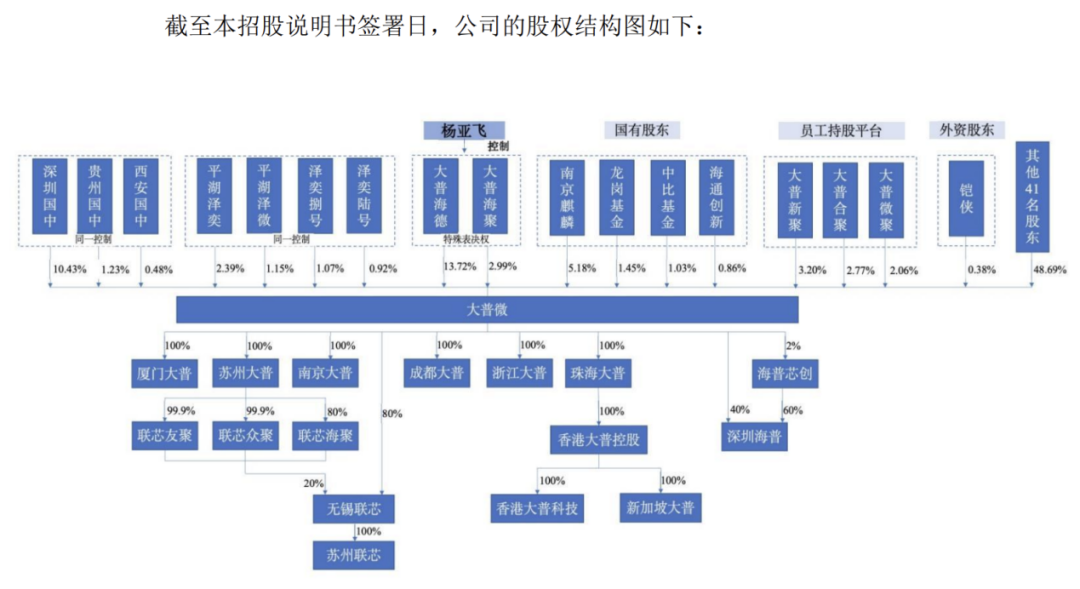
Looking through DapuStor's shareholder list, one can almost piece together a map of Shenzhen's local VC institutions. Since its founding, the company has completed nearly ten financing rounds, raising a total of nearly RMB 2 billion. Before the IPO, founder Yang Yafei controlled a combined 16.71% of the company's shares through Dapu Haide and Dapu Haiju, making him the largest shareholder. Close behind were a group of Shenzhen VC firms that continued to increase their stakes from early to late stages.
As early as 2017, the team at Guozhong Capital saw the DPU concept and technical architecture proposed by DapuStor, made the first exclusive investment, becoming the first venture capital institution to support DapuStor, and subsequently added four more rounds. Before the listing, Guozhong Capital held approximately 12.14% of the shares, making it the second-largest shareholder.
Qifu Capital was also an early investor. In the early years, Qifu Capital invested tens of millions of yuan in DapuStor's Series A round. Its subsidiary, Qifu Guolong, held a 3.63% stake, making it one of the top ten shareholders before DapuStor's IPO.
Songhe Capital also made a significant investment in DapuStor. The Songhe team had been following DapuStor's business布局 since as early as 2017, with partners Zheng Xianmin and Feng Hua visiting the company to check on its progress. After years of tracking, when they learned in 2021 that DapuStor's enterprise SSD products had secured their first internet client, they made the decisive move to invest.
Around the same period, a fund under China Merchants Capital invested in DapuStor in 2021 and added more later that same year. With that, DapuStor became China Merchants Capital's fifth IPO of the year, following Biren Technology, Kaileshi, Huayan Robot, and Extreme Vision.
Another name, less conspicuous, is Zeyi Capital. Behind it is a post-80s leader, Chi Ke, who previously worked at Shenzhen Capital Group (SCGC) and later served as a partner at Qifu Guolong, where he helped drive the early investment in DapuStor. After founding Zeyi Capital independently, he continued to add to his stake across multiple subsequent funding rounds.
The presence of Shenzhen state-owned capital is equally dense. According to the prospectus, shareholders Tousai SEG, Tousou Chaoyue, Qianfan Qihang, and Guoying Junhe are acting in concert, together holding 2.25% of DapuStor's equity. Behind them is Shenzhen Investment Holdings Capital (SZIH Capital), which is under the actual control of the Shenzhen State-owned Assets Supervision and Administration Commission. SZIH Capital made its first investment in DapuStor in 2021. Later, in 2023, when the global storage industry experienced a cyclical downturn and capital market confidence in the semiconductor sector weakened, SZIH Capital bucked the trend and increased its stake.
Meanwhile, Longgang Fund and Longgang Jinteng are also acting in concert, holding a combined 1.91% of the equity, with the Shenzhen Longgang District Finance Bureau behind them. "The Longgang District not only provided us with site subsidies but also helped us connect with the technical needs of leading companies. This kind of 'precision irrigation' support has been crucial," Yang Yafei once remarked.
And it doesn't stop there. Behind DapuStor is also a long line of investors including SenseTime Guoxiang Capital, Infotech Ventures, Shanghai Guosheng Investment Group, Haitong Innovation, Qianshan Capital, and Suncrest Investment. Meanwhile, another unexpected name emerges — Nanjing State-owned Assets.
In 2020, Nanjing Qilin Sci-Tech Innovation Park, through a combination of investment and targeted recruitment, brought DapuStor's Nanjing R&D center into the park. The park's state-owned fund platform, Qilin Venture Capital, made an initial investment of RMB 80 million and participated in subsequent financing rounds, eventually acquiring a 5.18% stake in DapuStor, making it the largest state-owned shareholder. According to a disclosure by "Nanjing Release," based on the market capitalization on the first day of trading, the paper profit from Nanjing State-owned Assets' investment had approached nearly RMB 5 billion.
While the primary market feasted, retail investors who won IPO lots in the secondary market also got a slice of the gains. Based on the intraday high of RMB 255 per share, an investor who won one lot (500 shares) could make a profit of about RMB 100,000 — making DapuStor the second most profitable "lucky lot" on A-shares this year. Thus, DapuStor's IPO created a rare bonanza of returns.
03 The AI Wealth Creation Era
Right now, AI is reshaping the valuation logic of the entire capital market, and the ever-rising digital curves are dizzyingly exciting.
As of the close of trading on April 17, among the top ten A-shares by stock price, all but Kweichow Moutai were AI-related tech stocks. These included Yuanjie Technology, Cambricon, Zhongji Innolight, Muxi Shares, Moore Thread, QuantumCTek, Eoptolink, Robotec, and Hengdongguang. Each of these stocks traded above RMB 500 per share, concentrated in AI computing hardware segments such as optical communications, optical modules, and domestic computing power.
Among them, Yuanjie Technology, a leader in domestic optical chips, has surpassed Kweichow Moutai to become the new "king of A-shares," with its latest stock price exceeding RMB 1,440. Behind it is a post-70s Tsinghua academic elite — Zhang Xingang. His career began at a major foreign optical communications company. In 2013, he returned to China to start his own business, leading Yuanjie Technology to a listing on the STAR Market in 2022. Since 2025, riding the tailwind of AI computing power, Yuanjie Technology's stock price has surged over 900% cumulatively.
The most direct beneficiaries of this wave are the "pickaxe sellers" standing at the upstream of the AI industry chain. The market has given them an affectionate nickname — "Yi Zhong Tian" — referring to the three giants of the optical module sector: Zhongji Innolight, Eoptolink, and TFC Communication. On April 16, the total market capitalization of "Yi Zhong Tian" exceeded RMB 1.7 trillion, and by the next day it approached RMB 1.9 trillion.
Among them, Eoptolink's latest market cap has surpassed RMB 580 billion, hitting an all-time high. Its leader, Gao Guangrong, started his career in the optical communications industry at a wireless electronics factory in Chengdu after graduating from a technical secondary school. He founded Eoptolink only in 2008, when he was nearly 40 years old. It wasn't until the AI wave swept in that Eoptolink truly took off — its stock price accumulated nearly a tenfold increase over one year, making it the first company based in Chengdu to exceed RMB 500 billion in market capitalization.
Zhongji Innolight has just released an explosive earnings report: its net profit attributable to parent company shareholders in the first quarter of 2026 reached RMB 5.7 billion, a staggering 262% year-on-year increase, with quarterly profits already exceeding the full-year results of 2024, further driving its stock price to surge. To date, Zhongji Innolight's stock price has risen more than 550% this year, with its market cap approaching the RMB 1 trillion mark.
On the Hong Kong stock market, Zhipu and MiniMax have also seen explosive rallies. Zhipu's stock price once broke through the HK$1,000 mark, with its market cap briefly exceeding HK$400 billion.
Thus, large language models, GPUs, optical modules, optical chips, PCBs — from underlying computing power to upper-layer applications, from the primary market to the secondary market — AI is mass‑producing wealth across the entire chain.
Behind this is a global industrial revaluation: the technological capabilities that Chinese tech companies quietly accumulated over the past decade have finally found an outlet in the AI era. Those once‑overlooked, niche tracks that were considered "too hard, too slow, and too capital‑intensive" have now reached their cyclical turning point, becoming the most sought‑after targets in the capital market.
With this dramatic surge, the investors who once "sat on the cold bench" alongside the companies have finally welcomed their own moment of super returns.
All of this once again proves the lesson of history: no one can predict the direction of the tide, but time's rewards never fail to arrive.


 Whatsapp
 Email
Email Skype
Skype