

The company behind Lichuang Mall has just passed its IPO review.
Shenzhen Stock Exchange Listing Review Committee
Announcement on the Results of the 22nd Deliberation Meeting of 2026
The 22nd Deliberation Meeting of 2026 of the Shenzhen Stock Exchange Listing Review Committee was held on May 12, 2026. The deliberation results are hereby announced as follows:
I. Deliberation Results
Shenzhen Galaxia Technology Group Co., Ltd. (Initial Public Offering): Complies with the issuance conditions, listing conditions and information disclosure requirements.
From formal submission to the hearing approval, JLC Group spent around 35 months, nearly three years, and it has finally made new progress in its IPO journey.
As China’s largest platform for PCB prototyping and one-stop services across the electronics industrial chain, JLC is widely well-known among engineers and the chip distribution community. It boasts over 9.5 million registered users and processes more than 20 million orders annually. Nevertheless, it remains a relatively unfamiliar name in the capital market.
In this article, you will learn: the detailed progress of JLC’s listing process and why it has taken a relatively long time; how JLC’s performance has changed in recent years and its current operating status; what lies behind JLC’s business logic; and as fellow e-commerce platforms, what key differences exist between JLC and Yunhan IC City.
01 The Long Road to Listing
As a leading domestic one-stop service platform for the electronic industry chain, Jialichuang has had a bumpy road to listing.
In this offering, Jialichuang plans to list on the main board of the Shenzhen Stock Exchange, issuing no more than 62 million shares and raising RMB 4.2 billion, with Guotai Haitong Securities acting as the sponsor.
Looking back at Jialichuang's listing journey: In June 2023, it formally filed the application. In September of the same year, it voluntarily applied for a suspension of the review process due to the need to update financial data. Thereafter, the Shenzhen Stock Exchange issued two rounds of inquiry letters. The first round covered 23 core issues, including industry and business, business integration, related-party transactions, cash dividends, and fundraising projects. The second round focused on seven major areas, such as industry and business, the actual controller, and corporate governance.
The validity period of financial data is typically six months. Once the review process is prolonged, financial updates must be submitted repeatedly. From the end of 2023 to April 2026, this cycle repeated many times. During this period, Jialichuang's fundraising target was reduced from RMB 6.67 billion to RMB 4.2 billion—a nearly 40% decrease. On April 29, 2026, the second-round responses were fully submitted, and on May 12, the company was formally reviewed and successfully approved.
"Approval by the committee" means that the Shenzhen Stock Exchange's Listing Review Committee has passed the review. From the formal filing of the application to the approval, Jialichuang took approximately 35 months—nearly three years. However, even after committee approval, it still takes time before the official listing. Jialichuang's overall listing pace has not been particularly fast.
Why has Jialichuang's road to listing been so long? The company has not given an official explanation, but clues may be found from several aspects.
First, consider its financial performance. From 2023 to 2025, revenue showed overall growth, reaching RMB 6.726 billion, RMB 7.969 billion, and RMB 10.232 billion, respectively. Net profit attributable to the parent company stood at RMB 734 million, RMB 1.054 billion, and RMB 1.306 billion, respectively. The comprehensive gross margins were 27.14%, 28.84%, and 28.13%, respectively.
Looking at the business composition in 2025: the PCB business accounted for 37.96% of revenue, with a gross margin of 28.09%; electronic components accounted for 35.69%, with a gross margin of 19.95%; PCBA accounted for 17.48%, with a gross margin of 38.64%; and other businesses (3D printing, CNC, FA business, etc.) accounted for 5.44%, with a gross margin of 91.70%. Together, PCB and PCBA accounted for over 55% of revenue, clearly indicating a manufacturing-oriented business profile.
Although the overall picture looks decent, a persistently worsening trend is hidden within its core "bread-and-butter" business—PCB—specifically, its gross margin.
Jialichuang's PCB business gross margins from 2020 to 2025 were as follows: 43.62%, 29.02%, 23.44%, 28.73%, 30.13%, and 28.09%, respectively. Between 2020 and 2022, the PCB gross margin nearly halved.
Although gross margin recovered somewhat from 2023 to 2025, the margin for its medium-to-large volume boards (which accounted for 24.43% of the PCB business in 2025) slid continuously from 9.74% in 2023 to 2.79% in 2025—eroding by more than two-thirds in just three years. The prospectus attributed this to intense market competition and limited profit margins.
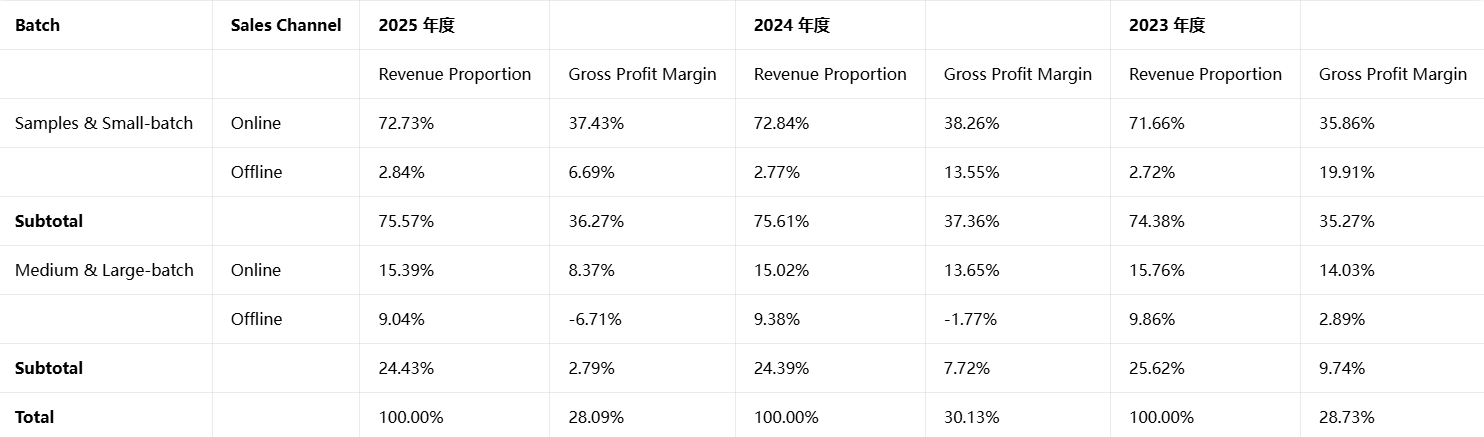
Source: Draft Prospectus (for Listing Review)
Jialichuang's PCB business consists of two major segments: Jialichuang and Zhongxinhua. The Jialichuang PCB segment operates through an online mall, primarily serving long-tail customers with prototype and small-volume needs. This segment is characterized by highly dispersed customer groups, low average order volume and unit price, short delivery times, etc., while offering relatively strong pricing power and higher gross margins.
The Zhongxinhua PCB segment conducts its business mainly through offline channels, primarily serving customers with medium-to-large volume needs. This segment features relatively higher order values, fewer orders, higher service costs, and pricing generally determined through bargaining with customers, resulting in relatively lower product prices and gross margins.
There are already many domestic manufacturers in the medium-to-large volume PCB market, where Jialichuang does not hold a competitive advantage. Meanwhile, the prototype and small-volume segment is also seeing a continuous influx of competitors. Currently, Jialichuang's high gross margins are primarily supported by its prototype/small-volume PCBs and PCBA. The Shenzhen Stock Exchange specifically inquired about this in its second-round letter, asking the company to explain the future development prospects and countermeasures for its medium-to-large volume board business.
Beyond the performance aspects, Jialichuang's equity structure and fundraising arrangements have also attracted considerable attention during the listing process.
In terms of equity, Jialichuang does not have a single controlling shareholder. Instead, Ding Hui, Yuan Jiangtao, and Ding Huixiang together hold 87.50% of the company's shares through direct and indirect means. The three signed a concert party agreement in December 2020 to jointly control the company. This agreement will expire 36 months after the listing.
The Shenzhen Stock Exchange specifically inquired about this matter in both rounds of questioning. In the second round, it further asked about the safeguard measures after the agreement expires, and whether disagreements among the joint actual controllers could lead to a deadlock in corporate governance.
In terms of fundraising, Jialichuang initially planned to raise RMB 6.67 billion. In the first round of inquiries, the Shenzhen Stock Exchange directly questioned the necessity and reasonableness of this amount. The target was ultimately reduced to RMB 4.2 billion, of which RMB 900 million was cut from the R&D center and IT upgrade project, RMB 800 million from the high-multilayer PCB production line construction project, RMB 400 million from the PCBA smart production line construction project, and RMB 370 million from other projects.
02 What Kind of Company Is Jialichuang?
To understand Jialichuang, one must first understand its positioning.
Jialichuang resembles an electronics industry chain service company built on a manufacturing foundation, rather than a traditional chip distributor. Even among e-commerce platforms for electronic component distribution, Yunhan operates more like a "distributor's distributor"—taking goods from large distributors and selling them to small- and medium-sized distributors or end customers. Jialichuang, by contrast, has taken a completely different path: starting with PCB manufacturing and gradually extending along the industry chain, with manufacturing serving as the foundation of its profits.
In 2006, Yuan Jiangtao founded Jialichuang with a sole investment of RMB 100,000. According to public information, Ding Hui, another founder of Jialichuang, left Xuzhou, Jiangsu for Shenzhen, starting as an apprentice before founding Shenzhen Zhongxinhua in 2004, focusing on PCB manufacturing.
According to a report by Hard Core (Yingke), Jialichuang did not have its own factory in its early days. Before setting up its own facility, its production site was Zhongxinhua's Foshan factory, which Zhongxinhua had wholly acquired in 2009. In other words, before their equity ties were formally established, Yuan Jiangtao's orders were already running on Ding Hui's production lines.
By 2012, this business relationship moved further toward equity binding. Ding Huixiang acquired 60% of Jialichuang's equity through a capital increase. In 2013, he transferred 30% of that equity to Ding Hui. Thereafter, Yuan Jiangtao, Ding Hui, and Ding Huixiang held 40%, 30%, and 30% respectively, forming the tripartite structure that gradually took shape. Meanwhile, the LCSC (Lichuang Mall) business had already started in 2011 and later became an important entry point for Jialichuang to enter the electronic components business.
In terms of capitalization, Jialichuang started later compared to Yunhan. Lichuang Electronics did not bring in its first external investor, Tianhexing, until 2018. According to public information, Tianhexing invested at a time when MLCC prices were high, contributing capacitor inventory as equity. Subsequently, Sequoia, Zhongding, CD Capital (CDIC), and others came on board.
The real turning point in Jialichuang's capitalization came with two acquisitions in 2021—acquiring the PCB business of Zhongxinhua for RMB 130 million in cash, and then acquiring Lichuang Electronics through a share swap valued at RMB 1.6 billion. The prospectus characterized these moves as integrating the upstream and downstream industry chain and resolving horizontal competition. The effects were indeed immediate: the acquisition filled the gap in medium-to-large volume PCB production capacity, brought component distribution under its umbrella, and completed the one-stop shop model—from prototyping to mass production, from boards to components.
At this point, Jialichuang's business logic became even clearer: first build a solid foundation in PCB, then extend step by step—you come here to get your boards made, and while you're at it, you buy the chips; after buying the chips, you get them assembled as well. Each step of extension serves the same group of customers, making for a highly cohesive narrative.
Specifically regarding PCBs, Jialichuang pioneered a "panelization" model—orders from different customers are densely arranged like puzzle pieces on standardized large panels. The cost of a single prototype run dropped from several hundred yuan to as low as a few dozen yuan, and delivery time was compressed from weeks to as fast as 12 hours. This approach fundamentally reshaped the cost structure of traditional PCB prototyping and is the core reason behind its ability to accumulate a massive user base. As of the end of 2025, it had over 9.5 million registered users and more than 1.3 million paying users.
The list of suppliers and customers often most directly reveals what kind of business a company is engaged in.
On the supplier side, according to the prospectus, Jialichuang's top five suppliers in 2025 were Guangdong Jiantao Copper Clad Laminate, Jiangxi Hongruixing Technology, Jinan Guoji Commerce (all copper clad laminate suppliers), Jiangxi Jiangnan New Material (copper balls), and Digi-Key Electronics. The first four are all PCB raw material suppliers, accounting for a combined 15.72% of total procurement.
Yunhan's 2025 annual report did not disclose the specific names of its top five suppliers, only stating that the total procurement amount from its top five suppliers was RMB 403 million, representing 14.23% of total annual procurement. Based on its disclosures in last year's prospectus, its top five suppliers are mainly chip distributors and original manufacturers. One company buys laminate boards; the other buys chips. The underlying business logic is evident simply from the nature of their suppliers.
On the customer side, Jialichuang's top five customers in 2025 were Megmeet, Holley Group (Hualee?), Shangyan Group, Haier Group, and Wasion Group, together accounting for only 1.16% of total revenue. Yunhan's top five customers together accounted for 7.16% of revenue.
In terms of order structure, Jialichuang's average order value is approximately RMB 500, with over 9.5 million registered users and more than 21 million orders per year. Yunhan's average order value is approximately RMB 3,900, with about 779,000 registered users and about 830,000 orders per year. The difference in average order value is nearly eightfold, while the difference in order volume is more than 25 times—they serve completely different customer groups.
In terms of gross margin, according to the prospectus, Jialichuang's PCB business gross margin is approximately 28%, and its PCBA business approximately 38%, with the manufacturing end serving as the primary source of profit. Its electronic components business gross margin is approximately 20%. Yunhan's 2025 gross margin for electronic components is approximately 16%. Compared to other chip distributors, neither company's gross margin is considered low.
03 Conclusion
The successful approval of Jialichuang's listing is an important attempt by the "Internet + Manufacturing" model to break into the A-share main board.
Unlike Yunhan, Jialichuang locks in profits through its manufacturing end, with performance that does not rely on market cycles. This is the most fundamental difference between it and similar e-commerce platforms, and it is also the confidence behind its bid for the main board with a scale of tens of billions in revenue. Previously, Yunhan landed on the ChiNext board, and Jialichuang followed closely with its pursuit of the main board. The fact that two e-commerce platforms have made it to the capital market one after another is a positive signal for the entire industry.


 Whatsapp
 Email
Email Skype
Skype