

A major domestic MLCC manufacturer raises 7 billion yuan and lists on the Hong Kong Stock Exchange today.
01 Sanhuan's Road to Listing
First, let’s clarify the fundamentals of this offering.
Sanhuan is offering a total of 71,364,300 H shares in this global offering (subject to the exercise of the over-allotment option), of which 7,136,500 shares (approximately 10%) are allocated to the Hong Kong public offering and 64,227,800 shares (approximately 90%) to the international offering. The sole sponsor and sole overall coordinator is China Galaxy International, with Huatai International, ICBC International, and BOCI International acting as joint global coordinators.
Notably, the cornerstone investor line‑up is quite impressive. According to the prospectus, Sanhuan has brought in as many as 17 cornerstone investors. Based on the offer price of HK$100.30 per share, the total cornerstone subscription amounts to approximately US$455 million, representing an aggregate of 35.55 million shares, or about 49.81% of the offered shares (assuming the over‑allotment option is not exercised). In other words, nearly half of the offering shares are locked up by cornerstone investors.

Source: Prospectus
To understand Sanhuan’s Hong Kong listing this time, the recent rally in passive components must also be mentioned.
The rally began in April 2025, when major manufacturers such as Panasonic and Kemet (under Yageo) successively raised tantalum capacitor prices, setting the stage. From November, the price increases spread to resistors, inductors, ferrite beads, and other categories. In December, domestic Chinese manufacturers like Fenghua Hi‑Tech also issued price‑increase notices one after another. Entering 2026, around New Year’s Day, the spot market saw suspended quotations and price hikes; after the holiday, resistor prices overall rose by about 10%–20% compared with pre‑New Year levels, while capacitor prices saw modest increases overall, but certain tight models—such as polymer tantalum capacitors and high‑capacitance, high‑voltage ceramic capacitors—remained in short supply.
The real acceleration came in late May. In particular, during the last week of May, the passive components market suddenly surged, with suspended quotations reappearing. In early June, resistor prices rose significantly, while capacitor prices changed “every day,” with some part numbers “rising 2 to 5 times, and even more for high‑capacitance types.” Goldman Sachs even called MLCC the “next supply bottleneck” in the AI industry chain. Currently, the resistor and capacitor market remains hot, but appears to have cooled somewhat compared with before.
Amid this market fervor, Sanhuan completed its Hong Kong share offering:
At the end of October 2025, Sanhuan announced its plan to pursue an H‑share listing;
On 5 December, it filed its first listing application with the Hong Kong Stock Exchange;
On 3 June 2026, it disclosed that its H‑share offering had been filed with the CSRC;
On 5 June, the initial application lapsed automatically as it had not been approved within six months;
On 8 June, the company refiled an updated application;
On 12 June, the CSRC publicly posted the filing information on its official website;
On 30 June, the prospectus was formally published, and the public offering was launched on the same day;
On 9 July, the H shares officially began trading.
As for the use of proceeds, the prospectus provides fairly detailed disclosure, dividing them into three categories.
According to the prospectus, approximately 48.8% (HK$3.441 billion) will be used for technological iteration and material innovation, to consolidate the company's integrated technological moat and advance domestic substitution in critical areas. About 41.2% (HK$2.900 billion) will be allocated to overseas new construction, expansion, and automation, primarily in Thailand and Germany. This includes the solid oxide fuel cell (SOFC) project in Thailand, new production lines for electronic components for data centers, expansion of communication devices, and the high‑precision piezoelectric micro‑dispensing system project in Germany. These projects are scheduled to commence construction by the end of 2026, with a total additional production capacity of approximately 36.7 billion units. The remaining roughly 10% (HK$705 million) will be used for working capital and general corporate purposes.
02 What kind of company is Sanhuan?
Sanhuan's story begins in 1970. That year, a group of workers from the Chaozhou No. 2 Light Industry Bamboo Products Factory switched to making electronic components and set up the Chaozhou No. 1 Radio Component Factory in a small temple called "Laojun Tang" – which was the predecessor of Sanhuan. Over the next half‑century, the company progressed from in‑house R&D of ceramic powders to self‑manufacturing of equipment, building a complete vertical industrial chain. It was listed on the ChiNext Board of the Shenzhen Stock Exchange in December 2014, and following this Hong Kong listing, it has formally established an "A+H" dual listing structure.
In terms of business segments, Sanhuan's products are divided into four major categories. According to the 2025 annual report, by revenue:
● Electronic components (including MLCC, MLCI, and fixed resistors): revenue of RMB 3.308 billion, up 43.95% year‑on‑year, with its share of total revenue rising from 31.16% in the previous year to 36.73%.
● Communication components (ceramic ferrule and sleeve, ceramic package base, optical communication ceramic package housing, etc.): revenue of RMB 2.594 billion, up 12.50% year‑on‑year, accounting for 28.80% of total revenue.
● Electronic and ceramic materials (alumina/aluminum nitride ceramic substrates, electronic pastes, SOFC electrolyte support sheets, etc.): revenue of RMB 1.959 billion, up 16.82% year‑on‑year, accounting for 21.75% of total revenue.
● Equipment and components (ceramic bonding tools, piezoelectric micro‑dispensing systems, SOFC stacks, etc.): revenue of RMB 602 million, up 12.09% year‑on‑year, accounting for 6.68% of total revenue.
If there is one defining characteristic of this company, it is its several "global No. 1" positions.
According to Frost & Sullivan data cited in the prospectus, based on 2025 revenue, Sanhuan ranked first globally in three product categories: ceramic ferrules and sleeves, alumina ceramic substrates, and SOFC electrolyte support sheets. Specifically, ceramic ferrules and sleeves accounted for approximately 70% of the global market, while alumina ceramic substrates accounted for over 50%.
So where does Sanhuan stand in its fastest‑growing segment last year – MLCC?
The global MLCC supply side is highly concentrated, with the top few manufacturers accounting for the vast majority of the market share. Murata of Japan holds the largest share, followed by Samsung Electro‑Mechanics of South Korea in second place, and Taiyo Yuden of Japan in third. Sanhuan's global share remains relatively limited, at just 2.5%.
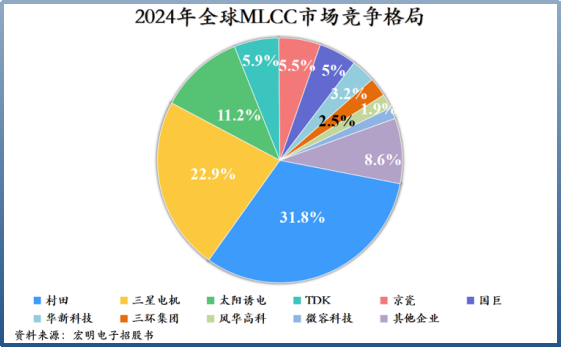
Source: Prospectus of Hongming Electronics
Technologically, Sanhuan has already established itself as a top‑tier domestic player in the MLCC space in China. According to the prospectus, its high‑end MLCC dielectric layer thickness has been reduced to approximately 1 micron, with stack layers exceeding 1,000, and its high‑capacitance products are already in mass production. However, moving up to the next level – "ultra‑high capacitance" – is still dominated globally by Murata, Samsung Electro‑Mechanics, and Taiyo Yuden. Overall, Sanhuan is a global leader in its core ceramic materials business, but in the much larger MLCC market, it remains a challenger.
From 2023 to 2025, Sanhuan's operating revenues were RMB 5.727 billion, RMB 7.375 billion, and RMB 9.007 billion, respectively, representing a 22% year‑on‑year growth in 2025. Net profit attributable to shareholders was RMB 1.581 billion, RMB 2.190 billion, and RMB 2.618 billion, respectively, up 19.54% year‑on‑year in 2025. In terms of gross margin, it stood at 42.14% in 2025, down 0.85 percentage points year‑on‑year, yet still at a relatively high level for the industry.
Entering 2026, growth has accelerated further: in the first quarter, operating revenue reached RMB 2.681 billion, up 46% year‑on‑year, while net profit attributable to shareholders was RMB 791 million, up 48% year‑on‑year. The company attributed this to continued improvement in customer recognition of its MLCC products, coupled with growing demand from the optical communications and other industries.
In terms of customer structure, Sanhuan is relatively diversified. According to its 2025 annual report, the company's top five customers together accounted for 14.94% of total sales, with the largest single customer representing only 3.67%.
However, a few figures are worth noting. From 2023 to 2025, the company's accounts receivable increased year by year; by the first quarter of 2026, operating cash flow had declined by more than 35% year‑on‑year. The underlying reasons and sustainability of this trend will require data from subsequent quarters to verify.
03 Conclusion
As an electronic ceramics company deeply rooted in Chaozhou for over 55 years, Sanhuan has turned its ceramic craftsmanship into global No. 1 positions across multiple product categories, including alumina ceramic substrates, ceramic ferrules and sleeves, and SOFC electrolyte support sheets. This Hong Kong listing is aimed at securing funding for the next phase of its global capacity expansion.
However, in the MLCC segment, which has recently garnered significant attention, Sanhuan remains a challenger, with a notable gap in global market share compared to Murata and Samsung Electro‑Mechanics. Having completed its listing amid this market rally and backed by 17 cornerstone investors, how well Sanhuan can develop its growth story from here is something that only time will tell.


 Whatsapp
 Email
Email Skype
Skype