

ST Latest Financial Results: General-Purpose MCU Revenue Surges, How Is the Spot Market Performing?
01 General-Purpose MCUs Post Sharp Growth, Tight Supply Across Multiple Markets
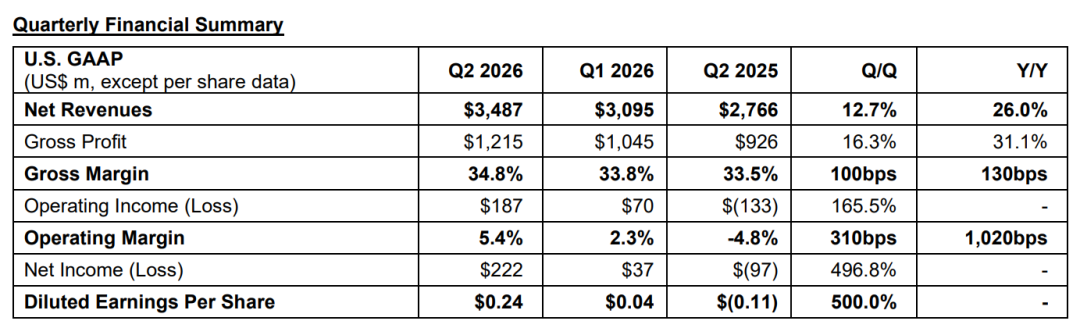
STMicroelectronics released its Q2 2026 financial results on July 23. The company posted net revenues of USD 3.49 billion in the second quarter, representing a 26% year-on-year increase and a 12.7% quarter-on-quarter rise, driven primarily by revenue growth across its CECP (Communications, Equipment, Computers & Peripherals) and Automotive segments.
Gross margin stood at 34.8% in Q2, up 130 basis points year over year. This improvement stemmed from reduced costs associated with idle production capacity and optimized product mix. The operating profit margin reached 5.4%, with a net profit of USD 222 million, compared to a net loss of USD 97 million recorded in the same period last year. On a non-GAAP basis, gross margin was 35.2%.
Breakdown by business segment, all of ST’s product divisions achieved year-on-year revenue growth in the second quarter.
Analog, Power, Discrete Devices, MEMS & Sensors (APMS) Division
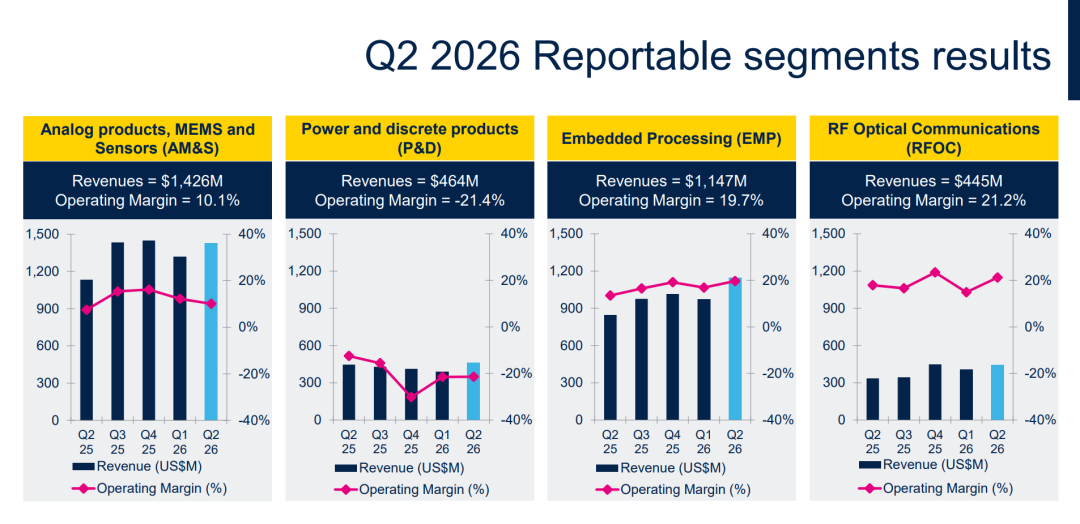
Revenue for Analog, MEMS and Sensors (AM&S) reached USD 1.426 billion, rising 26% year on year, driven chiefly by imaging solutions and MEMS products, alongside modest contributions from analog offerings.
Power & Discrete Devices (P&D) posted revenue of USD 464 million, a 3.7% year-on-year uptick, the slowest growth among the four business units. Its operating loss widened from USD 56 million in the prior-year period to USD 99 million.
Microcontrollers, Digital ICs & RF (MDRF) Division
Embedded Processing (EMP) revenue totaled USD 1.147 billion, surging 35.5% year on year, primarily fueled by robust growth in general-purpose microcontrollers (MCUs).
RF & Optical Communications (RF&OC) generated revenue of USD 445 million, up 32% year on year.
The MCU-focused EMP segment stood out as the top performer. Its 35.5% year-on-year growth rate was the highest across all divisions. As explicitly stated in the earnings report, this stellar performance was led by general-purpose MCUs, with custom processors and secure connectivity chips also delivering meaningful contributions.
Meanwhile, the segment’s operating margin climbed from 13.5% in the same period last year to 19.7%.
Let’s look at a few more signals related to the spot market.
ST indicated that demand continued to grow further in the quarter, with orders performing strongly and the overall book‑to‑bill ratio close to 2. The ratio stood well above 1 across all end markets and was significantly above 2 in the CECP (Communications, Equipment, Computers and Peripherals) segment, driven primarily by robust performance in optical connectivity, including silicon photonics. In addition, ST noted that it sees clearer market prospects across multiple product categories, along with signs of supply tightness.
Looking at the specific downstream markets:
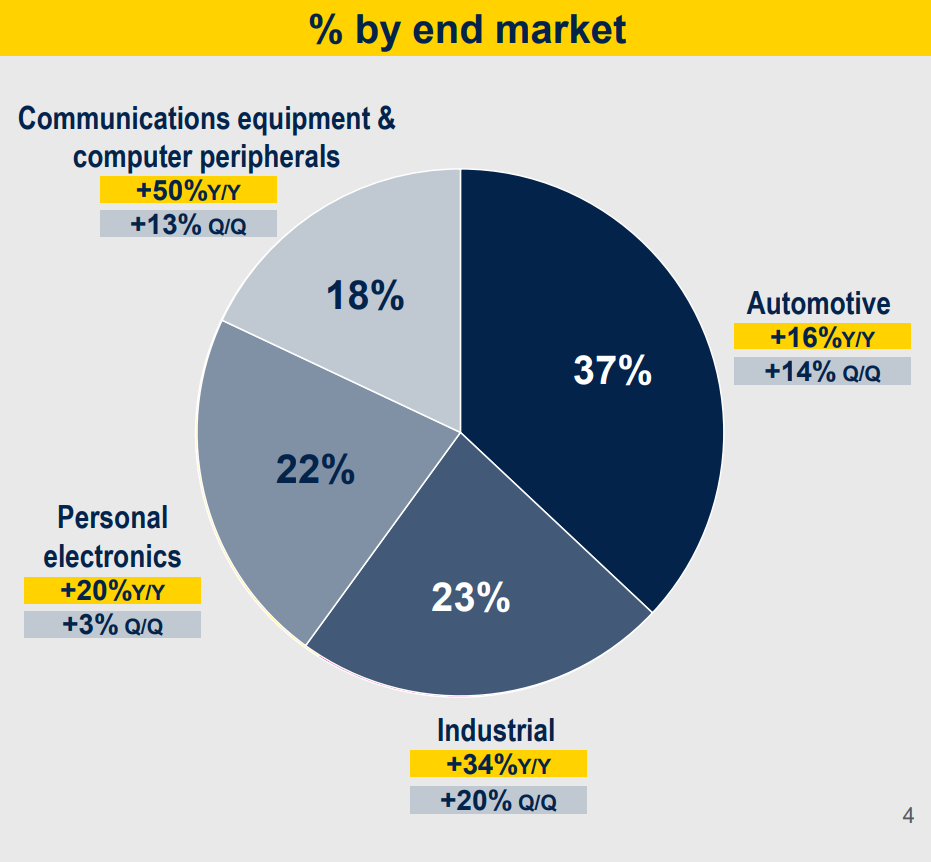
Automotive: Revenue came in better than expected, up 14% sequentially and 16% year‑over‑year. Growth was driven by the company’s strong position in dedicated ICs and sensors for traditional applications, electric powertrains, and ADAS. ST also mentioned that the NXP MEMS sensor business acquired in February has won key customer orders.
Industrial: Revenue grew 20% sequentially and 34% year‑over‑year. Importantly, distribution channel inventory declined further and is now below the standard target level. This solid growth was driven by general‑purpose microcontrollers and analog products (with their broad ecosystem), supplemented by dedicated analog products and power conversion offerings. ST also announced a further expansion of its collaboration with NVIDIA to accelerate physical AI.
Personal Electronics: Revenue increased 3% sequentially and 20% year‑over‑year. Growth was driven by higher content per device in engaged customer programs, as well as better‑than‑normal seasonality.
Communications, Equipment, Computers and Peripherals (CECP): Second‑quarter revenue exceeded expectations, rising 13% sequentially and 50% year‑over‑year. The growth was driven by engaged customer programs and custom‑designed products, supported by microcontrollers used in optical connectivity.
Inventory continued to decline. At the end of the second quarter, ST's total inventory stood at $3.19 billion, with little change sequentially, but Days Sales Inventory (DSI) decreased to 126 days from 140 days in the previous quarter, compared to 166 days in the same period last year. The earnings report repeatedly noted that distribution channel inventory declined further and is now below the company's standard target level.
As for the outlook, ST's guidance is also relatively optimistic. For the third quarter, revenue is expected to be $3.7 billion, representing year‑over‑year growth of approximately 16.2% and sequential growth of about 6.2%, plus or minus 350 basis points. Gross margin is expected to further improve to approximately 37%, plus or minus 200 basis points. In the fourth quarter, the company expects revenue to exceed $4.0 billion, primarily driven by the implementation of key customer projects in the AI data center and low‑earth orbit satellite communications sectors.
ST's growth momentum remains strong, with continued robust demand seen in the AI data center segment. The company currently expects revenue from this segment to exceed $1.0 billion in 2026; if the current momentum persists and based on ST's existing cooperative projects, revenue from this segment is firmly expected to surpass $2.0 billion in 2027.
02 Chip Spot Market – What's the Current Situation?
Back to the spot market. The ST hype started to pick up around mid‑to‑late June and fully exploded in early July.
According to third‑party search trend data, the turning point came in the week of June 22. Prior to that, the search interest for regulars like the STM32F103C8T6 and STM32F405RGT6 was even declining sequentially, but from that week onward, they climbed for three consecutive weeks, with the increase hitting a new high in the week of July 6. The models appearing on the top‑search list also expanded from the F1 and F4 series to the H7 and STM8, and within the top 50 searches, G0, L4, F7, and even MEMS sensors began to show up.
In terms of pricing, several hot market models had already risen significantly by mid‑July: the STM32F405RGT6 went from RMB 14 to 18, with quotes ranging from 22 to over 30 yuan; the STM32F103C8T6 traded at around 5.2 yuan, with market quotes exceeding 7 yuan; the STM32F407VET6 rose from 18 to 25 yuan; and the STM32H743VIT6 skyrocketed directly from 42 to 65 yuan.
How did these increases come about? Most distributors attribute them to a combination of several factors: ST's price‑increase notice, the circulation of lead‑time extension documents, rumors of channel control measures, all amplified by market sentiment.
In mid‑July, we learned that market sentiment had become somewhat divided. Some said these parts were indeed in short supply, while others felt that supply was actually ample. When it came to actual transactions, many distributors admitted that the bulk of trading was still between peers. Quotes changed from day to day, with a wide spread between high and low offers. As for the market outlook at that time, some believed prices would continue to rise, others thought it was just sentiment‑driven speculation, and the majority remained on the sidelines.
Over the past week or so, the buzz around ST chips has started to cool since last week, with market chatter gradually fading. Among the previously hot chips, some saw slight price declines, while others remained relatively firm.


 Whatsapp
 Email
Email Skype
Skype