

Shenzhen’s RMB 100 Billion IPO Surges 177% on Debut! The Company Behind Lichuang Mall Goes Public
01 What Are the Differences Between Jialichuang and Yunhan?
To understand Jialichuang, one must first grasp its market positioning.
From the perspective of chip distributors, Lichuang Mall under Jialichuang is a well-known e-commerce platform for electronic components. To engineers, it serves as a handy one-stop tool for PCB prototyping and component procurement. However, Jialichuang is not a distributor in the traditional sense; instead, it is an electronic industrial chain service enterprise underpinned by manufacturing capabilities.
When discussing the divide between manufacturing and trading, we have to mention Yunhan IC City, which was listed on the ChiNext Board of the Shenzhen Stock Exchange last year. Yunhan and Lichuang are often mentioned together, yet the two run fundamentally different businesses.
Although both operate e-commerce platforms for electronic component distribution, Yunhan essentially acts as “a distributor to distributors”. It sources goods from large component distributors and resells them to small and medium-sized distributors or end customers. Jialichuang follows a completely different path. Starting out with PCB fabrication, it has gradually expanded its reach along the industrial chain, with manufacturing forming the bedrock of its profits.
A company’s supplier and customer lists often offer the most straightforward insight into its core business.
On the supplier side, according to its prospectus, Jialichuang’s top five suppliers in 2025 were Kingboard Laminates Guangdong, Jiangxi Hongruixing Technology, Jin’an Guoji Commerce (all suppliers of copper-clad laminates), Jiangxi Jiangnan New Materials (copper balls), and Digi-Key Electronics. The first four all supply PCB raw materials, accounting for a combined 15.72% of total purchases.
Yunhan did not disclose the specific names of its top five suppliers in its 2025 annual report, only revealing that aggregate purchases from these suppliers reached RMB 403 million, representing 14.23% of total annual procurement. Combined with disclosures in its prospectus filed last year, its major suppliers are primarily chip distributors and semiconductor manufacturers. One firm purchases board materials, while the other procures chips — their respective business logic is clearly reflected in the profile of their suppliers.
Turning to customers, Jialichuang’s top five customers in 2025 were Megmeet, Huali Technology Group, Shangyan Group, Haier Group and Wasion Group, whose combined revenue share stood at merely 1.16%. For Yunhan, the top five customers contributed 7.16% of total revenue.
In terms of order structure, Jialichuang’s average order value was approximately RMB 500. It had over 9.5 million registered users by the end of 2025 and recorded more than 21 million orders in 2025. Yunhan posted an average order value of roughly RMB 3,900, with around 779,000 registered users and about 830,000 annual orders. The average order value differs by nearly eight times, and total order volume varies by more than 25 times, meaning the two platforms serve entirely distinct customer groups.
Furthermore, previous data indicates there is little difference between Jialichuang’s order volumes on weekdays and weekends. By contrast, Yunhan’s weekend order volume is only one-tenth of its weekday level. Taken together, these disparities suggest Jialichuang boasts a large base of individual users including students and engineers, alongside substantial business clients, while Yunhan likely serves more small and medium-sized B-end customers.
In terms of gross profit margins, prospectus filings show Jialichuang registered a gross margin of 28.09% for its PCB business and 38.64% for its PCBA business, with manufacturing operations acting as its primary profit driver. Its electronic components business delivered a gross margin of 19.95%. Yunhan recorded an electronic components gross margin of approximately 16% in 2025. Compared with other chip distributors, both companies maintain relatively healthy gross profit margins.
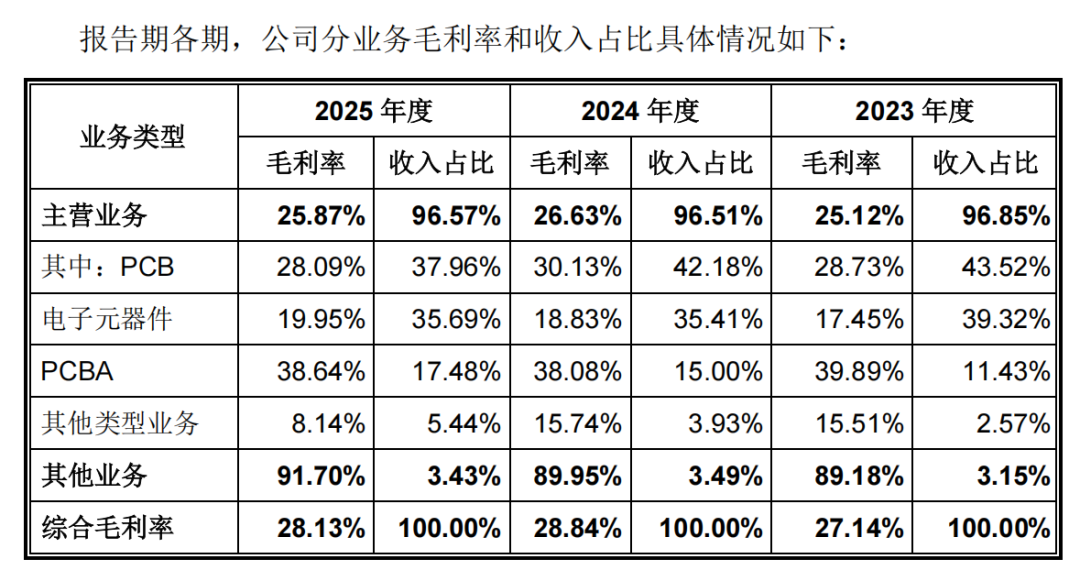
Source: Jialichuang Prospectus
From suppliers and customers to average order value and gross profit margins, Jialichuang and Yunhan, these two seemingly similar e-commerce platforms, are actually pursuing two distinct paths: manufacturing and trading.
So how did Jialichuang build its manufacturing-driven business step by step?
02 From a single counter in Huaqiangbei to a market value of hundreds of billions
The story of Jialichuang begins with two men.
The first is Yuan Jiangtao. Before founding the company, he worked as an electronics engineer at a drone enterprise in Shenzhen. In 2006, he invested 100,000 yuan to establish Jialichuang, focusing on small-batch PCB prototyping services.
The second is Ding Hui. Together with his younger brother Ding Huixiang, he hails from Xuzhou, Jiangsu Province. Ding Hui moved south to Shenzhen in his early years, rising from an apprentice to a supervisor. In 2004, he founded Shenzhen Zhongxinhua, specializing in medium and large-batch PCB manufacturing.
Long before the two entities were linked via shareholding ties, their businesses were already closely intertwined. According to public information, Jialichuang did not own its own production facilities in its early days. Prior to building its own factories, its production took place at Zhongxinhua’s plant in Foshan. In other words, orders secured by Yuan Jiangtao were manufactured on Ding Hui’s production lines from the very start.
In 2012, Ding Huixiang increased capital in Jialichuang and became its major shareholder. In the following year, he transferred part of his equity to Ding Hui. Thereafter, Yuan Jiangtao held a 40% stake, Ding Hui 30%, and Ding Huixiang 30%, forming this three-shareholder ownership structure. On another front, Lichuang Mall was launched and put into operation back in 2011, later evolving into a vital gateway for Jialichuang to expand into the electronic components business.
In terms of capitalization, Jialichuang got off to a later start compared with Yunhan. Lichuang Electronics brought in its first external investor, Sky Star, only in 2018. Public records show that MLCC prices stood at a high level when Sky Star made the investment, and it contributed capital in the form of capacitor inventory valuation. Later, Sequoia Capital, Zhongding Capital, SDIC Investment & Management and other investors successively took equity stakes.
The turning point for Jialichuang’s capital development arrived with two acquisitions in 2021. Jialichuang acquired the PCB business under Zhongxinhua for RMB 130 million in cash, and purchased Lichuang Electronics via a share swap valued at RMB 1.6 billion. The prospectus characterized these transactions as moves to integrate upstream and downstream resources and resolve horizontal competition. The results were immediate. Medium-to-large batch PCB production capacity was supplemented, and the components distribution business was brought in-house. A true one-stop closed-loop ecosystem was established, covering services from prototyping to mass production, and from circuit boards to electronic materials.
Incidentally, Jialichuang’s self-developed board-level EDA industrial software originated from its acquisition of EasyEDA in the early stage. The platform now boasts over 6.58 million cumulative registered users worldwide, and many industry insiders regard this as one of its core competitive advantages.
Jialichuang has delivered impressive financial results in recent years. From 2023 to 2025, its operating revenue reached RMB 6.726 billion, RMB 7.969 billion and RMB 10.232 billion respectively. Net profit attributable to parent company stood at RMB 734 million, RMB 1.054 billion and RMB 1.306 billion, reflecting steady growth. Particularly noteworthy is its PCBA segment. Revenue surged from RMB 769 million to RMB 1.789 billion, more than doubling within three years. Its revenue proportion rose from 11.8% to 18.11%, making PCBA one of Jialichuang’s fastest-growing business divisions. Synergies across its manufacturing operations are gradually taking effect.
Nevertheless, beneath the glowing financial figures lies a continuously deteriorating indicator within Jialichuang’s core fundamentals: the gross profit margin of its PCB business.
Jialichuang’s PCB business, which accounted for 39.31% of total revenue in 2025, consists of two segments.
The first segment covers prototypes and small-batch orders fulfilled via its online store, contributing 75.57% of PCB revenue and acting as its absolute mainstay. This business features highly diversified customers, small average order sizes and short lead times, granting the company strong pricing power. During the reporting period, gross margins for online prototype and small-batch services remained steady between 35% and 38%.
The second segment is medium and large-batch PCB operations acquired from Zhongxinhua, representing 24.43% of PCB revenue. These orders are served through offline channels with large customers negotiating terms. While unit prices are higher, gross margins are thinner.
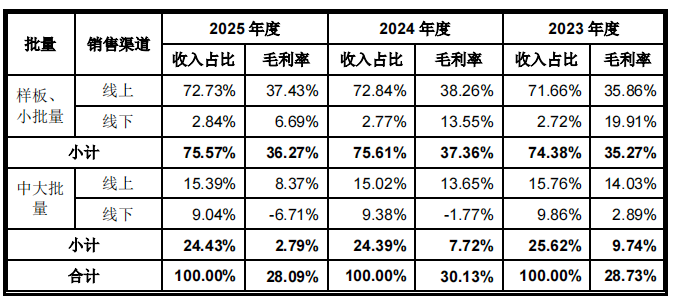
Source: Jialichuang Prospectus
The crux of the problem lies in its medium and large-batch PCB segment.
Its overall gross margin tumbled from 9.74% in 2023 to merely 2.79% in 2025, slumping by more than half within three years. A breakdown reveals an even more alarming picture. While online medium and large-batch orders maintained a gross margin of 8.37%, offline medium and large-batch business registered a gross margin of -6.71%. In other words, this segment is already loss-making, with conditions worsening year on year: the gross margin stood at 2.89% in 2023, dropped to -1.77% in 2024, and further deteriorated to -6.71% in 2025. The prospectus attributes this trend to fierce market competition and squeezed profit margins.
There are numerous domestic manufacturers engaged in medium and large-batch PCB production, meaning Jialichuang lacks competitive advantages in this field. Meanwhile, new competitors keep entering the prototype and small-batch PCB market. At present, Jialichuang’s robust gross profit levels are mainly underpinned by its prototype & small-batch PCB business and PCBA operations. In the second round of inquiry letters, the Shenzhen Stock Exchange raised targeted questions on this matter, demanding the company elaborate on the development outlook and countermeasures for its medium and large-batch PCB business.
Manufacturing constitutes Jialichuang’s moat. It is also what differentiates the firm from Yunhan and gives it resilience to weather semiconductor industry cycles. Yet even this moat has vulnerable weak points.
03 Conclusion
Previously, Yunhan secured its listing on the ChiNext Board, and now Jialichuang has debuted on the Main Board. The two electronic component e-commerce platforms stepping into the spotlight one after another bodes well for the whole industry.
Yet comparing the two lays bare their distinctly different strategies. Yunhan leans toward trading, with its performance rising and falling in lockstep with semiconductor market cycles. Jialichuang is manufacturing-focused and comparatively less vulnerable to market swings. Each has carved out its own path, alongside its own set of challenges to resolve.
An IPO is never a finish line; it marks the start of another chapter. Whether Jialichuang — now armed with a market capitalization in the hundreds of billions and nearly ten million users — can defend its core prototype and small-batch business base and sustain its one-stop service narrative remains to be seen over time.


 Whatsapp
 Email
Email Skype
Skype