

Analog chip giants TI and ADI are bouncing back!
01 What Do the Earnings Reveal? Both Are Accelerating, but the Details Differ.
Let's first look at the two companies' latest core metrics.
ADI reported revenue of $4.022 billion for its fiscal third quarter ended August 1, 2026, up 40% year‑over‑year and 11% sequentially, marking the company's first‑ever single‑quarter revenue above $4 billion. TI, for its second quarter ended June 30, posted revenue of $5.463 billion, up 23% year‑over‑year and 13% sequentially.
On a year‑over‑year basis, ADI grew faster, while the two were relatively close in sequential growth. Overall, TI still has the larger revenue base, roughly 1.36 times that of ADI.
Looking over a longer time horizon, both companies have climbed from their troughs to where they are today, but the trajectories of their recoveries have taken different shapes.
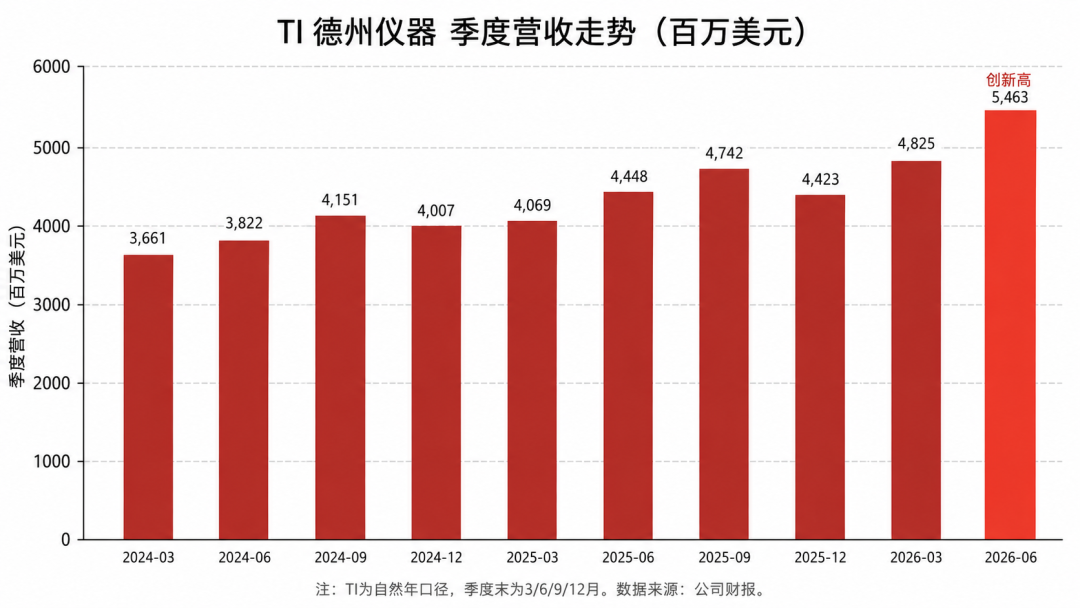
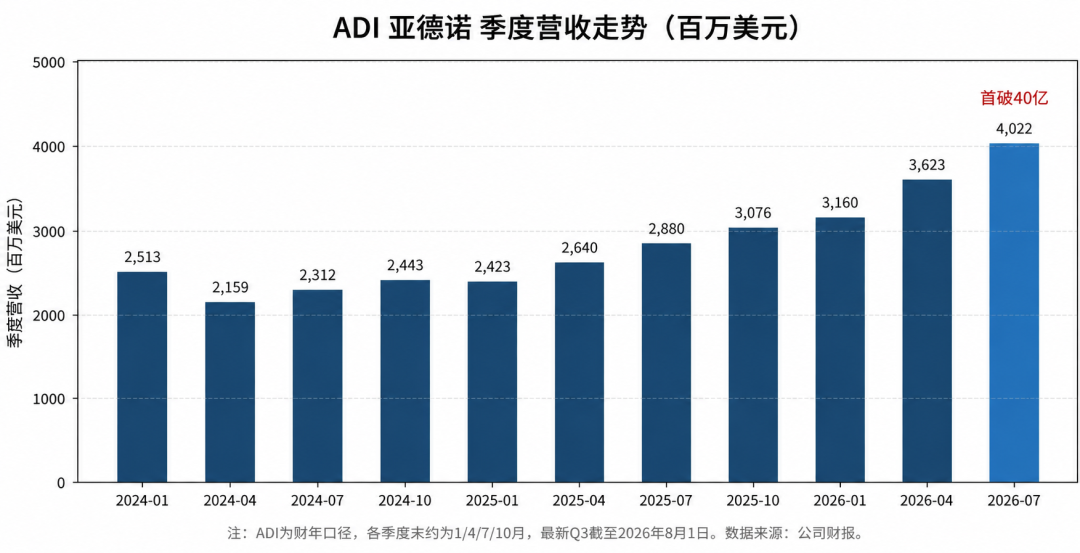
Both companies saw their quarterly revenues hit recent‑year lows in early 2024. TI bottomed out in the first quarter of 2024 (at $3.661 billion for the period ended March 31), while ADI reached its trough in its fiscal second quarter (at $2.159 billion for the period ended April 30). Since then, both have recovered, but at different paces. TI's revenue fluctuated up and down over the previous two years, and only this year did it post two consecutive quarters of clear upward momentum. ADI, on the other hand, hovered near its low for about a year before starting to grow noticeably; after entering 2025, its growth became more steady, gradually pushing revenue above the $4 billion mark.
Now turning to the business mix. For this quarter, TI described its performance as "firing on all cylinders." Industrial (which accounted for 33% of total revenue in 2025) grew roughly 30% year‑over‑year; data center (9% of revenue) more than doubled its revenue from a year earlier; automotive (33%) posted year‑over‑year growth in the mid‑teens percentage range, with a clear rebound within the quarter; personal electronics (21%) remained flat; and communications equipment (3%) grew both year‑over‑year and sequentially. All segments moved upward simultaneously.
ADI also posted year‑over‑year growth across all four major end markets, with industrial and communications standing out. In the latest quarter, industrial accounted for 49% of total revenue, up 53% year‑over‑year. Communications made up 16%, surging 84% year‑over‑year, with the data center business now representing 80% of that segment's revenue. Automotive accounted for 25%, up 16% year‑over‑year, and consumer contributed 10%, up 6% year‑over‑year.
Industrial and data center were the common growth drivers for both companies. However, TI placed greater emphasis on the simultaneous improvement across multiple end markets, with automotive turning from weak to strong—a new development this quarter. ADI, by contrast, saw its most outstanding performance in the industrial and communications segments.
On gross margin, ADI more commonly reports on a non‑GAAP adjusted basis, with its latest quarterly gross margin at 72.5%. TI, on the other hand, consistently uses GAAP‑based metrics. When comparing on the same GAAP basis, ADI's latest gross margin stood at 67.3% versus TI's 61%, still leaving ADI with a sizeable lead.
ADI's gross margin has been steadily improving since the fourth quarter of fiscal 2024, while TI's gross margin fell below 60% in the fourth quarter of 2023 and has fluctuated since then, only finally returning above that level in the current quarter.
On the inventory front, the picture is reversed. TI ended the second quarter with $4.6 billion in inventory, down $90 million from the previous quarter. Its inventory days stood at 196, a sequential decrease of 13 days, marking two consecutive quarters of decline. ADI, by contrast, continued to see inventory build, reaching a record high of approximately $1.93 billion. However, its days inventory outstanding fell to 156, and channel inventory weeks have already dropped below the target level of 6–7 weeks.
On guidance, both companies are projecting further growth. ADI expects next‑quarter revenue of approximately $4.3 billion, plus or minus $100 million—if achieved, it would mark another quarterly record. TI forecasts third‑quarter revenue in the range of $5.65 billion to $6.15 billion, representing sequential growth of roughly 3% to 13%, and expects all end markets to remain robust in the third quarter.
02 Where Do the Differences Come From?
At first glance, the two companies appear quite similar: both are posting revenue growth, both are being driven by industrial and data center markets, both are seeing gross margins recover, and both have raised guidance. But when you look closer, the emphases of their growth drivers differ.
TI attributed its strong quarter primarily to a broad‑based recovery across industrial and other segments. Management believes the industrial market is still in the process of recovering—while it has clearly grown, it remains below the peak levels of 2022. At the same time, data center build‑outs are also driving related demand in areas such as energy infrastructure and test and measurement.
Automotive was a new development this quarter. TI attributed its rebound to the Chinese market, particularly the uptake of electric and hybrid vehicles, as well as the fact that customers' inventories had dropped to relatively low levels. Once demand returned, restocking followed naturally.
In ADI's explanation, AI played a much more prominent role. Management combines data center and ATE (automatic test equipment)‑related businesses into what it calls its "AI exposure," which together currently accounts for 20% of ADI's overall business. Within the data center segment, both ADI's optical and power products posted over 100% year‑over‑year growth. In addition, the company also cited growth opportunities from defense and the long‑term increase in chip content per device.
Unlike TI, ADI doesn't just talk about the present; it also provides a longer‑term outlook. ADI's management revealed that its estimated serviceable addressable market (SAM) for data center and energy markets in 2030 has more than doubled from a year ago.
Putting the two companies' narratives together, the common ground is clear: both rely on industrial recovery, data center/AI, and long‑term market demand growth, and both emphasize that this cycle is not simply about inventory restocking but genuine end‑demand. The difference lies in their focus—TI's growth is more diversified, while ADI leans more heavily on the AI theme.
On inventory, the two have taken different approaches. ADI's inventory reached a record high this quarter, which management described as intentional "strategic inventory" built to support growth demand. At the same time, its channel inventory has fallen below the normal six‑to‑seven‑week level. Low channel inventory suggests that end‑demand recovery is outpacing inventory replenishment, and the proactive build‑up of inventory also reflects ADI's positive outlook on future demand.
TI's inventory remained largely flat, with a slight decrease of $90 million, still sitting at a high level of $4.6 billion. Its inventory days have declined for two consecutive quarters, down to 196 days. However, the inventory value has not actually dropped significantly; the decline in inventory days comes partly from reduced inventory and partly from revenue growth improving inventory turnover efficiency. So it cannot be simply interpreted as TI destocking.
The divergence in inventory strategies between the two companies also reflects differences in their underlying supply chain conditions, including lead times, capacity, pricing, and more.
Turning to supply, ADI has already begun to feel some supply pressure. In July, ADI notified customers that lead times for certain products had been extended to up to six months, and advised customers to place orders through channel partners at least six months in advance to secure future supply. In the spot market, some chip distributors have also reported that ADI's lead times have been lengthening recently, with some orders placed a few months ago still not yet delivered.
TI, by contrast, is in a much more comfortable position. Its lead times remained below 13 weeks in the second quarter, though they have increased by a few weeks from earlier levels as demand has grown. Management believes that TI's lead times are still the most competitive in the industry. On capacity, TI's factory utilization rate improved in the second quarter compared with the first, and continued to rise as the quarter progressed. Management even stated that with the current capacity layout, TI will have "no issues" with capacity over the next three years.
Turning to pricing, both companies have issued price increase notices this year. TI issued two rounds of price hikes, effective in April and July respectively. ADI's price increases took effect in February and September this year.
The two companies also differ in their views on the impact of these price adjustments. TI management explicitly stated that in the next quarter's revenue growth guidance, the price contribution is "almost negligible," with the vast majority of growth coming from higher shipment volumes. ADI, on the other hand, acknowledged that price increases are one of the factors driving gross margin improvement, and noted that the full effect of the price hikes has not yet been fully realized, with the impact continuing to unfold in subsequent quarters.
In the spot market, after ADI's price increase notice in December 2025, a wave of sentiment‑driven price hikes swept through the market. Many said some customers were stocking up in advance, while others described the reaction as relatively muted. When the price increase officially took effect in February 2026, some distributors reported that customers maintained normal procurement rhythms, but others saw an uptick in ADI demand and slight lead‑time delays. In July, following the new price increase notice, according to Quiksol, demand for both popular and niche models increased slightly, and prices for some models continued to rise.
On the TI side, after the price hike news spread in early March, quotations for some popular part numbers—especially general‑purpose components—rose rapidly, and the market showed signs of tightening, though demand had not yet fully heated up. However, by mid‑to‑late March, the situation began to reverse, and those once‑red‑hot top‑tier chips started to see price declines. After the Qingming holiday, some models even saw prices cut in half. Following the July price increase notice, some models saw price rises, but there was no broad‑based significant increase. That said, Quiksol noted that TI's overall lead times have generally extended, from the original 8–12 weeks to 16–20 weeks.
03 Conclusion
Over the past few years, the analog chip industry has gone through inventory adjustments and sluggish demand.
Now, as demand recovers in industrial, data center, and AI infrastructure markets, the industry is showing signs of a rebound. But this recovery is not simply a cyclical bounce; the demand structure is also shifting. Both TI and ADI, standing in the same analog chip recovery cycle, have taken different paths.
TI relies on a broader market footprint and pre‑prepared capacity to capture the demand recovery, while ADI is positioning itself ahead of the curve through "strategic inventory" build‑up to support future growth. Looking ahead, as AI infrastructure continues to expand, it remains worth watching which company can better translate demand into sustainable growth.


 Whatsapp
 Email
Email Skype
Skype