
“TI’s Earnings Are Still Soaring—How’s the Spot Market Doing?”
01 Revenue Continues to Grow, Gross Margin Keeps Improving
TI’s third-quarter revenue was $6.06 billion, up 11% quarter over quarter and 28% year over year; operating profit was $2.874 billion, up 73% year over year; net profit was $2.425 billion, up 78% year over year.
By business segment, Analog revenue was $4.911 billion, up 32% year over year; Embedded Processing revenue was $858 million, up 21% year over year; other revenue was $286 million, down 6% year over year.
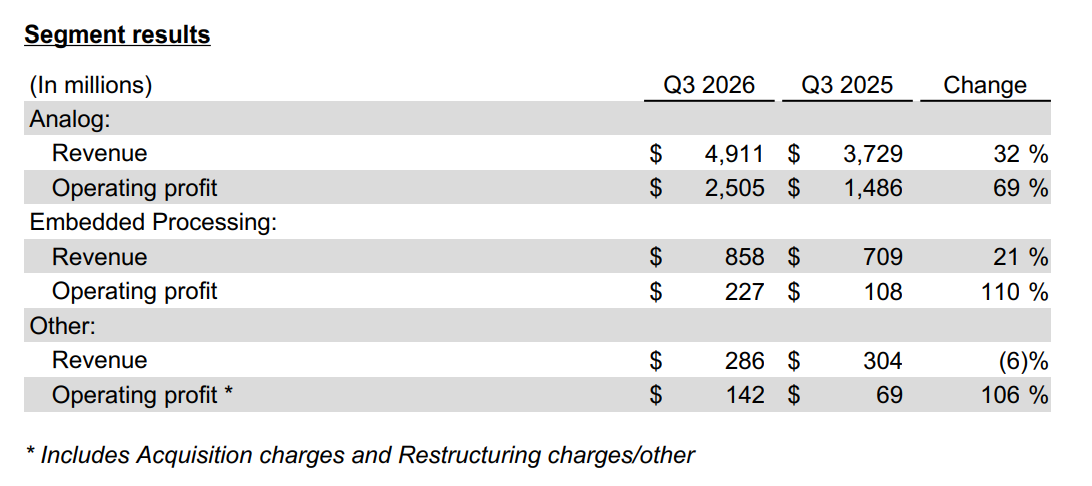
Source: Texas Instruments FY26 Q3 Earnings Report
In terms of end markets, “industrial, automotive, and data center continued to see broad-based growth,” said Haviv Ilan, chairman, president, and CEO.
In the third quarter, the industrial market grew by more than 40% year over year and about 10% quarter over quarter, returning after four years to the high level seen in the third quarter of 2022; data center revenue surged 95% year over year and rose about 20% quarter over quarter; the automotive industry grew by a low-teens percentage year over year and about 10% quarter over quarter; personal electronics were roughly flat year over year and up high single digits quarter over quarter; communications equipment achieved growth both year over year and quarter over quarter.
Looking back at TI’s end-market performance this year, some markets led in the first quarter, industrial, automotive, and data center jointly drove growth in the second quarter, and by the third quarter multiple end markets had achieved broad-based growth.
TI’s gross margin also continued to improve, rising to 64% in the third quarter, up 280 basis points quarter over quarter, mainly driven by revenue growth and favorable pricing dynamics. The chief financial officer said, “Our third-quarter profitability was primarily driven by revenue growth.”
TI expects fourth-quarter revenue to be between $5.8 billion and $6.3 billion, with the midpoint of the revenue guidance at $6.05 billion, essentially flat compared with the third quarter. Management noted that this expected performance is better than the usual fourth-quarter seasonal level, mainly supported by demand in the data center, industrial, and automotive markets.
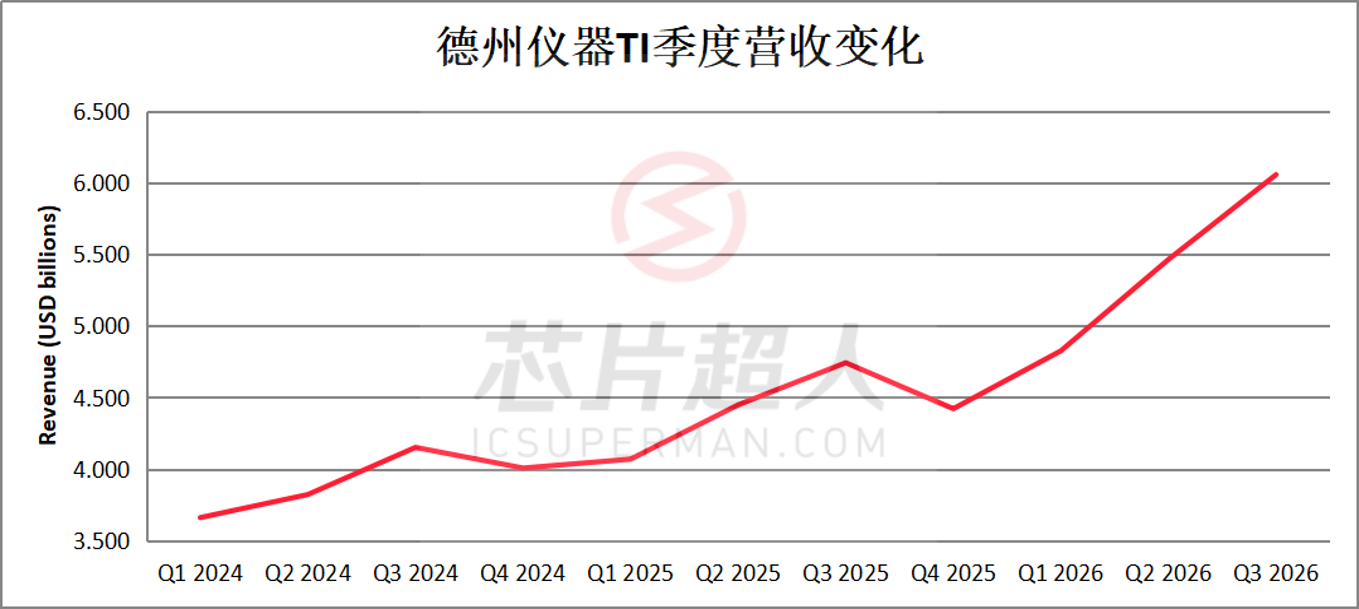
Looking back at the revenue trend over the past few years, TI’s current recovery did not happen overnight.
Starting in the fourth quarter of 2022, TI’s revenue began to decline year over year, and it remained under pressure in 2023 and 2024, with the downturn lasting for nearly two years. In the first quarter of 2024, revenue fell to about $3.661 billion, marking a阶段性 low point in this round of adjustment. It was not until the fourth quarter of 2024 that the year-over-year decline narrowed. The real turning point came in the first quarter of 2025, when TI’s revenue returned to year-over-year positive growth, and in the following quarters the recovery trend gradually became clearer.
Entering 2026, TI’s growth clearly accelerated. First-quarter revenue reached $4.83 billion, up 19% year over year; second-quarter revenue further increased to $5.46 billion, up about 23% year over year; and in the third quarter it exceeded $6 billion, reaching $6.055 billion, up 28% year over year and 11% quarter over quarter, setting a new single-quarter revenue high in recent years.
02 Inventory, lead times, and price hikes—what’s going on?
TI’s revenue continued to grow in the latest quarter, while inventory, lead times, pricing strategy, and capital expenditure also released some signals worth watching.
TI’s third-quarter inventory was $4.7 billion, an increase of $67 million from the previous quarter. Inventory days stood at 194 days, down 2 days quarter over quarter, marking the third consecutive quarter of decline.
On lead times, TI said on its earnings call that demand in its three major markets—industrial, automotive, and data center—is continuing to expand, and overall demand is strong across markets, industries, and regions, putting pressure on lead times and potentially leading to slightly extended delivery cycles.
On pricing, TI said on the earnings call that product prices in the first half of 2026 were basically flat year over year. In the second half, prices rose to some extent, but this year’s increase was not significant. At the same time, TI has begun discussing 2027 pricing and supply assurance. TI said more information on price changes may not be available until it reports results—especially issues guidance—in January next year.
TI also said it expects 2026 capital expenditure to be between $2 billion and $3 billion, with spending likely at the high end of that range. The company said it will plan capacity for the remainder of this decade and adjust investment according to demand and growth targets. It also noted that longer lead times for back-end equipment could affect the pace of capital expenditure execution in 2026.
In the chip spot market, TI launched its second and third price increases of the year on July 1 and September 1, respectively (the first was in April). The multiple price adjustments mainly point to rising supply chain costs and changes in the market environment, compounded by recovering demand in industrial control, automotive, and data centers. TI’s overall lead times are also continuing to lengthen, with lead times for some part numbers reaching 48 weeks or more.
Affected by factors such as price increases, TI’s popularity on chip trading platforms has clearly heated up since August. In September, multiple part numbers in the market drew attention, covering applications such as industrial, communications, and automotive, with automotive chips especially in hot demand. Prices for TI chips used in automotive, industrial, and server-related applications have risen noticeably, but some general-purpose parts are still seeing price competition, resulting in market divergence.


 Whatsapp
 Email
 Skype