
ADI, the “Moutai” of Analog Chips, Delivers Another Blowout Quarter
01 Revenue Hits a Record High
Strong Growth Across Multiple Markets
ADI’s fourth-quarter revenue (for the quarter ended October 31, 2026) was $4.373 billion, up 42% year over year and 9% quarter over quarter; operating profit was $1.869 billion, up 98% year over year; and net income was $1.650 billion, up approximately 110% year over year.
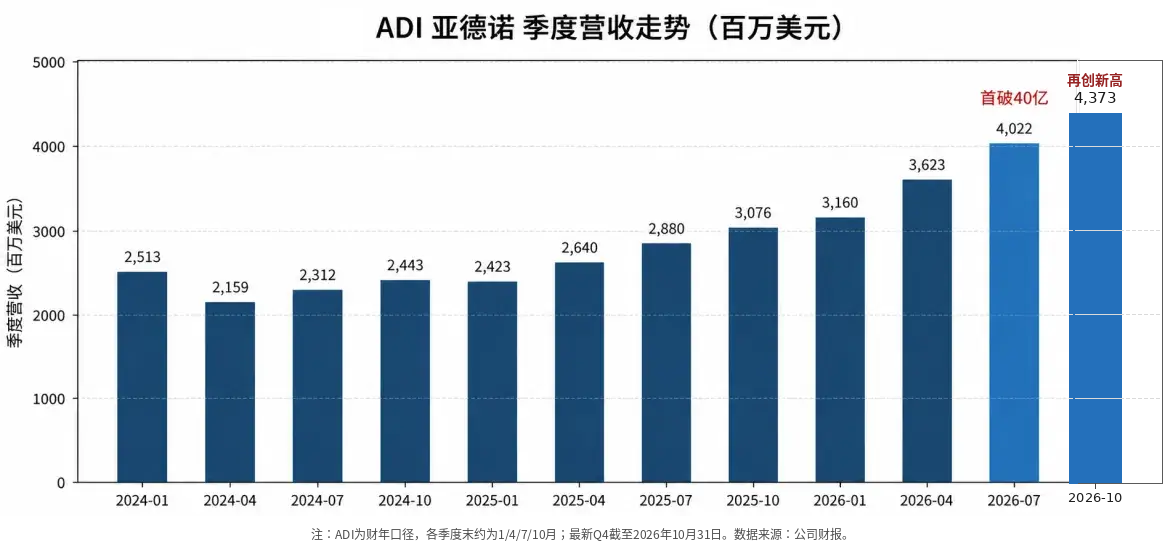
For full fiscal year 2026, ADI’s revenue reached $15.179 billion, up 38% year over year and a record high; operating profit was $5.858 billion, up 100% year over year; and net income was $4.997 billion, up approximately 120% year over year.
Looking back, ADI “bottomed out” in the second quarter of fiscal 2024 and hovered at low levels for about a year. Since 2025, it has begun to grow clearly, with relatively stable growth over the past two years, and it set new highs in the most recent two fiscal quarters.
By end market, in the fourth quarter, industrial market revenue reached $2.194 billion, up 55% year over year and 11% quarter over quarter; automotive market revenue was $1.044 billion, up 21% year over year and 5% quarter over quarter; communications market revenue was $707 million, up 81% year over year and 8% quarter over quarter; and consumer electronics market revenue was $429 million, up 7% year over year and 7% quarter over quarter.
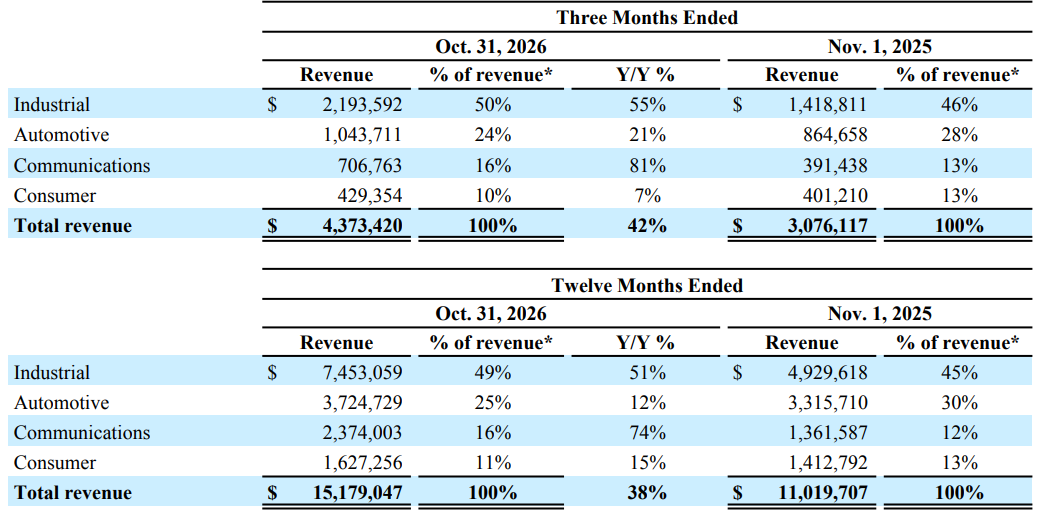
In terms of full-year performance, the industrial, automotive, communications, and consumer electronics markets grew by 51%, 12%, 74%, and 15%, respectively.
The industrial market became an important driver of ADI’s full-year growth, with growth achieved across multiple areas including aerospace and defense, automated test equipment (ATE), and electronic test and measurement. Revenue from the ATE and electronic test and measurement businesses hit record highs for the full year.
The automotive market set a new revenue record for the second consecutive year. Despite pressure on global automotive production and sales, product share and per-vehicle value continued to rise in areas such as ADAS and in-vehicle infotainment systems, while the battery management system (BMS) business returned to growth after two consecutive years of decline.
The communications market became ADI’s fastest-growing end market for the second consecutive year, mainly driven by demand from AI data centers. In fiscal 2026, data center revenue grew by more than 90% year over year, with continued growth in demand for power management and optical communications-related products, making it one of ADI’s fastest-growing business areas.
The consumer electronics market grew 15% year over year in full-year revenue, supported by applications such as high-end smartphones, wearables, wireless earbuds, and gaming, despite some pressure from memory-related costs.
Vincent Roche, ADI’s Chairman and CEO, said that AI infrastructure investment is driving rapid growth in the data center and automated test equipment businesses, but more than two-thirds of the company’s growth in fiscal 2026 came from non-AI core markets, reflecting the company’s growth momentum across multiple end markets.
The company also said that, starting in the first quarter of fiscal 2027, the communications market will be split into data center and wireless communications. Data center will be reported as a standalone end market, while wireless communications revenue will be included in the industrial market.
In terms of profitability, ADI’s fourth-quarter GAAP gross margin was 69.3%, up 620 basis points year over year; adjusted gross margin reached 74.5%, up 470 basis points year over year and 200 basis points quarter over quarter. For the full year, adjusted gross margin was 72.9%, up 360 basis points year over year; adjusted operating margin was 49.5%, up 760 basis points year over year. Management said the gross margin improvement was mainly driven by product mix optimization and revenue growth.
The CEO also revealed that ADI’s average selling price (ASP) is more than 4 times the industry average, and that the ASPs of next-generation products are even higher. In addition, management explicitly stated that, given current capacity utilization and tight supply, further increasing capacity utilization in the short to medium term will no longer be a main driver of gross margin improvement; future improvement will rely more on revenue growth and product mix optimization.
For the first quarter of fiscal 2027, based on the midpoint of guidance, revenue is expected to increase about 0.6% sequentially from $4.373 billion in the prior quarter to $4.4 billion, better than typical seasonality.
02 How Is the Spot Market Doing?
This earnings report still contains several new signals worth paying attention to for chip distributors.
On inventory, ADI’s own inventory continued to increase in the fourth quarter. As of the end of the fiscal year, the company’s inventory reached $2.084 billion, an increase of about $152 million from the previous quarter; days of inventory (DIO) also rose from 156 days to 165 days.
On the distribution channel side, inventory levels have recovered to the company’s target range of 6–7 weeks, but management still believes channel inventory is relatively lean and expects total channel inventory to be roughly flat next quarter, with weeks of inventory possibly declining.
At present, ADI’s order growth is not entirely driven by customers restocking. Management said that the book-to-bill ratio in almost all end markets is above 1, and orders and shipments to a broad customer base are also growing, but there are no signs yet of widespread large-scale restocking by customers. At the same time, multiple stages—including wafer manufacturing, back-end manufacturing, external wafer foundry, and packaging and testing—continue to face supply tightness.
To cope with demand growth and supply uncertainty, ADI is increasing bare die inventory and finished-goods safety stock, and plans to further expand capacity. Management believes that the company is still in the middle of the current market recovery cycle.
Original manufacturer orders are growing and upstream capacity supply is tightening. So how has ADI performed in the market so far this year?
In February 2026, ADI’s first round of price increases was officially implemented. Some customers maintained their normal purchasing pace, while some distributors also felt that demand was increasing and lead times had slightly lengthened.
Entering the second half of the year, changes on the supply side gradually became more evident. In July, ADI notified customers that lead times for some products had been extended to as long as six months, and some distributors reported that ADI lead times had lengthened. In August, supply of some part numbers tightened, and spot price volatility increased. In September, after a new round of price increases was officially implemented, prices for certain industrial-grade, automotive-grade, and scarce parts rose noticeably, while prices for general-purpose parts remained relatively transparent.
In the past two months, long lead times for some ADI products and price pressure have persisted. However, price divergence remains, and general-purpose parts with large market circulation are facing price competition.
Some distributors said that recently they have mainly been matching orders, with occasional stocking. In their view, ADI parts that are in shortage remain tight, while price competition for general-purpose parts that are not in shortage is very fierce, and prices for some part numbers have fallen noticeably recently.
For example, for the dual-channel precision operational amplifier OP2177ARZ-REEL7, large-volume shipments could still fetch $4.8 in early September, when channel prices were also difficult to negotiate; now the market target price has dropped to below RMB 20 (excluding tax). For another product, the RS-232 interface transceiver MAX3232ESE+T, the current market selling price is even lower than the distributor’s procurement cost in July.
One channel distributor specializing in ADI reported that part numbers currently in shortage remain tight, with prices staying high and basically flat recently. However, customers’ acceptance of high prices is no longer as strong as during the 2021 chip shortage.
Another distributor mainly handles relatively niche part numbers with low market circulation. Prices for such products have generally risen recently, and prices are also relatively hard to negotiate.
Another distributor also reported that although they do not handle many ADI products, overall performance this month has been fairly good, mainly concentrated on a small number of part numbers where they have channel advantages.
At the same time, some distributors have felt that demand has cooled recently. One distributor admitted that the domestic and international customers they deal with had much less demand this week than last week—not only were orders fewer, but even inquiries declined, and the market has clearly become quieter.
03 Summary
The original manufacturer delivered a record-revenue annual report, but the feel in ADI’s spot market still shows a temperature gap. Some parts are scarce and prices remain firm, while for some parts the selling price has already fallen below procurement cost. Even for part numbers in shortage, quotes may stay high, but customers are not necessarily willing to pay. In the same market cycle, the business opportunities brought to different players have clearly diverged. At this stage, opportunities are more concentrated in specific part numbers and channel advantages.


 Whatsapp
 Email
 Skype