
Japan’s Power Semiconductors: A Major Shift Looms?
01 The initial driving force was "Toyota".
The whole affair began when Denso submitted a takeover proposal for Rohm via a tender offer (TOB).
When media reports of the plan surfaced, Denso declined to issue an official comment, while Rohm confirmed it had received the acquisition proposal from Denso. The two companies previously reached an agreement to maintain a strategic partnership, and Denso also holds approximately 5% of Rohm’s outstanding shares. The question then arises: why is Denso unwilling to simply uphold this existing partnership, and instead moving forward with a full acquisition of Rohm?
DENSO is a core supplier of the Toyota Group, and its moves appear to be inextricably linked to Toyota’s corporate strategy. Initially, the author assumed that “this initiative stemmed solely from DENSO’s own judgment, with no involvement from Toyota.” However, after consulting industry insiders in the automotive sector, the feedback received was that “the project is being pushed forward by DENSO under Toyota’s directives.”
It is reported that Toyota’s fundamental policy is to bring its supply chain under internal control. Even if full in-house production is unfeasible, the group is committed to securing a certain volume of self-produced or quasi-in-house manufactured components.
Silicon carbide (SiC) power semiconductors are set to become a critical component amid the ongoing electrification of vehicles. Against this backdrop, Toyota’s rationale behind bringing Rohm, Japan’s largest SiC manufacturer, into its supply ecosystem early on is likely rooted in this strategic mindset.
02 “Common Sense Differences ”between the Automotive Industry and the Semiconductor Industry
As the world’s largest automaker, Toyota centers its supply chain on tier-one suppliers including DENSO and Aisin Seiki, while continuously deepening capital ties with enterprises that hold core technologies.
This policy arguably underpins the company’s robust business performance. In times of critical component shortages where automakers must compete fiercely for supplies, owning component manufacturers within its corporate group ensures Toyota will not lose out in such scrambles.
Power semiconductors have become indispensable for vehicle electrification. For electric vehicles (EVs) equipped with larger-capacity batteries, silicon carbide (SiC) power semiconductors outperform silicon-based alternatives in cutting power loss. It is likely based on this logic that Toyota moved to bring Rohm into its ecosystem before the competition over SiC devices intensified.
While this maneuver is consistent with Toyota’s long-standing business style and thus easy to comprehend, as an observer from the semiconductor industry, I cannot help but feel sympathy for Rohm.
Rohm was originally an independent semiconductor manufacturer with low reliance on any single key customer. It used to specialize in PC peripherals and consumer electronics, yet its automotive segment has accounted for over half of its total sales in recent years.
Automotive semiconductors feature a high proportion of MCUs, analog chips and power semiconductors, with a smaller share allocated to memory and logic products. As a specialist in analog components and discrete devices, Rohm has long strived to bolster its power semiconductor lineup. Particularly in silicon carbide (SiC), the company has rolled out the most aggressive investment and development initiatives among Japanese manufacturers, ranking among the world’s top five players in this field. This strength is presumably what attracted Toyota and DENSO to the firm.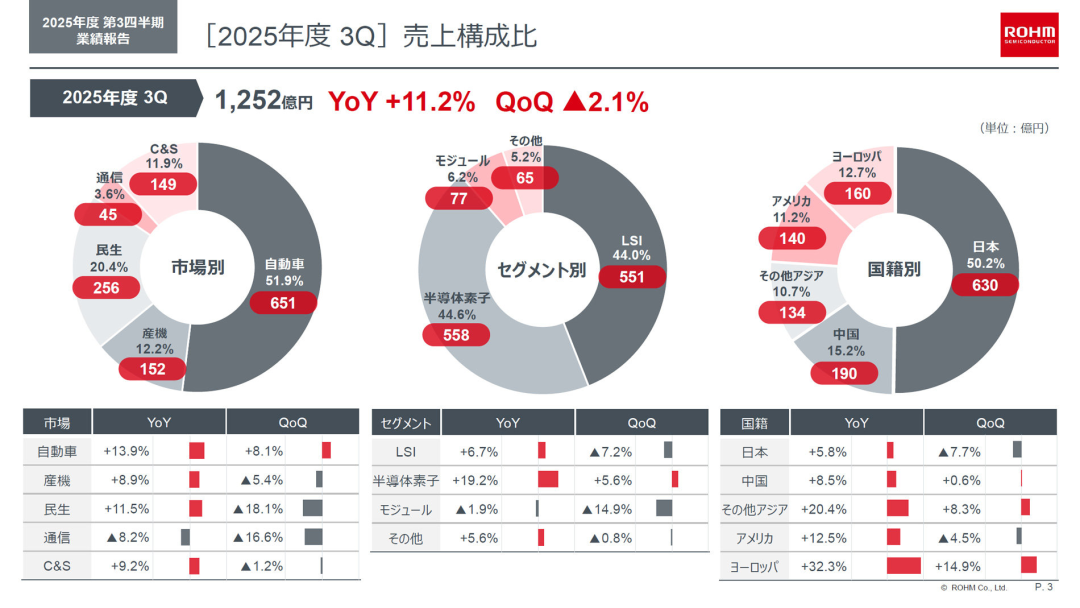
Breakdown of Rohm’s sales revenue for the third quarter of the fiscal year ending March 2026 Source: Excerpted from Rohm’s Q3 FY2026 earnings presentation materials
But what would become of Rohm’s other automotive businesses if it were acquired by DENSO?
DENSO is undoubtedly Rohm’s largest customer, yet it accounts for merely 15% to 20% of Rohm’s automotive revenue at most. The remaining 80% to 85% of automotive sales include orders from DENSO’s rivals such as Bosch, and most of this business would vanish. Even if Rohm were willing to maintain those partnerships, DENSO would bar it from supplying Bosch. Meanwhile, Bosch would refuse to source semiconductors from a Rohm under DENSO’s ownership.
Besides automotive products, non-automotive segments make up nearly half of Rohm’s total sales. Demand for SiC in industrial equipment, in particular, is projected to surge sharply in the years ahead, yet these operations will likely face stringent restrictions imposed by DENSO as well.
In short, once a semiconductor manufacturer is acquired by a single major customer, its client pool will be tightly constrained, which will drastically erode the company’s corporate value.
DENSO’s proposed acquisition offer of 1.3 trillion Japanese yen sent Rohm’s share price surging overnight. However, should the acquisition go through, Rohm’s sales to clients other than DENSO — estimated to account for roughly 90% of its total revenue — will no longer be secure. In the worst-case scenario, the company’s business scale could shrink to merely one-tenth of its current size.
While some players in the automotive industry have spoken positively of the deal, citing “synergy effects” and a “new wave of vertical integration,” Rohm is presumably on tenterhooks upon receiving this acquisition proposal.
03 The Integration Plan with Toshiba: A Desperate Countermeasure
After receiving the proposal, Rohm announced that it had established a special committee comprising outside directors and others, and that it was proceeding with its deliberations. The company stated that it "will make a judgment after careful and fair deliberation, together with other options that could enhance corporate value," and issued a policy to continue advancing the previously ongoing negotiations regarding "business integration with Toshiba."
Although Rohm claims that "this is not a countermeasure against Denso's acquisition proposal," it is clearly a desperate countermeasure. It is speculated that this stance stems from consideration for Denso, an important customer. However, faced with a proposal that would seriously undermine corporate value, it is impossible for Rohm to simply say, "Fine, we accept."
Furthermore, if Rohm were to remain silent and not respond to the proposal, it would very likely give Toshiba grounds to say, "If you are going to join Denso's group, then the business integration plan with Rohm should be scrapped." That is my view.
The business integration plan between Rohm and Toshiba's semiconductor operations was proposed in March 2024. On the surface, both parties are continuing negotiations on the basis of a consensus. The combination of Rohm, which specializes in SiC, with Toshiba's semiconductor business, which excels in silicon‑based power MOSFETs, is extremely logical. However, this integration plan has long failed to materialize and remains at a standstill.
In my view, the reason for this is clear: there are a considerable number of employees within Toshiba who are actually opposed to integrating with Rohm. Under these circumstances, Denso's acquisition proposal then emerged. For those Toshiba employees who oppose the integration, this must have appeared as an ideal opportunity to argue for scrapping the plan. It is therefore entirely understandable that Rohm has now revived the "integration with Toshiba" proposal at this particular juncture.
04 Joining Mitsubishi Electric's "Tripartite Alliance" Will Not Materialize
Of course, even so, this does not necessarily mean that the integration plan with Toshiba's semiconductor business will accelerate. The "true feelings" of Toshiba's employees are not so easily changed.
For Rohm, however, the situation has become extremely critical—it is at a turning point where its corporate value could be significantly impaired. The momentum behind pushing forward with the integration with Toshiba's semiconductor business should therefore be considerably stronger than before.
What surprised me, though, was the proposal to join a "tripartite alliance" with Mitsubishi Electric's semiconductor business.
If Rohm, strong in SiC, Toshiba, strong in MOSFETs, and Mitsubishi Electric, strong in IGBTs, were to combine forces, they would cover the major areas of power semiconductors and would be seen by industry leader Infineon as a "formidable rival." Japan's Ministry of Economy, Trade and Industry (METI), which is committed to promoting "power semiconductor strengthening," would likely look favourably upon such a plan and give it active support.
Not only has Rohm brought Toshiba on board, but it has even attempted to bring Mitsubishi Electric into the fold—this reflects just how "extremely cautious" and serious Rohm is in countering Denso's acquisition proposal.
However, from Mitsubishi Electric's perspective, is there sufficient motivation to agree to such a plan?
Although there have been reports that Kei Urushima, president of Mitsubishi Electric, is "positive about restructuring in the power semiconductor sector," I hold a different view. Mitsubishi Electric began constructing a 12‑inch wafer line for IGBT mass production at its Fukuyama Plant in Fukuyama City, Hiroshima Prefecture, in the second half of 2022. Prior to that, it had been mass‑producing using an 8‑inch line.
On the other hand, Toshiba announced as early as 2021 that it would build a 12‑inch line at its Kaga Plant in Nomi City, Ishikawa Prefecture, thus advancing its 12‑inch plans earlier than Mitsubishi Electric.
Since power semiconductors require not only processing on the front side of the wafer but also on the back side, the thicker 12‑inch wafers (compared to 8‑inch) necessitate significant adjustments in process design.
If we are to discuss the business integration of the two parties, the timing of the shift to 12‑inch wafers should have been the optimal opportunity. Fuji Electric, which has not advanced a 12‑inch wafer plan, is a different case—but for Toshiba and Mitsubishi Electric, wasn't the period from 2021 to 2022 really the time when they should have seriously discussed restructuring?
Perhaps they did actually explore it at the time, but now, at this late stage, saying that they are "positive about restructuring" would make me—and probably not just me—doubt the sincerity of that stance. For this reason, I believe that the "tripartite alliance" proposed by Rohm has an extremely low likelihood of materialising.
That concludes my view on this series of developments. Although it is expected to take several more months before a conclusion is reached, the rise of Chinese companies in the power semiconductor industry is remarkably rapid. Riding on the tailwind of government subsidies, they are advancing mass‑production preparations across all product areas—IGBTs, MOSFETs, SiC, and others. It seems that this field will continue to attract close attention for some time to come.


 Whatsapp
 Email
Email Skype
Skype