

Latest News on ST‘s Price Hike: Why Are MCUs Getting More Expensive?
01 Multiple MCU Manufacturers Have Raised Prices Successively
A look back at ST's price-increase announcements this year.
First, at the end of March this year, a price-increase notice allegedly from STMicroelectronics surfaced in the market. The notice stated that, due to rising costs, prices for multiple ST product lines would be raised effective April 26, 2026.
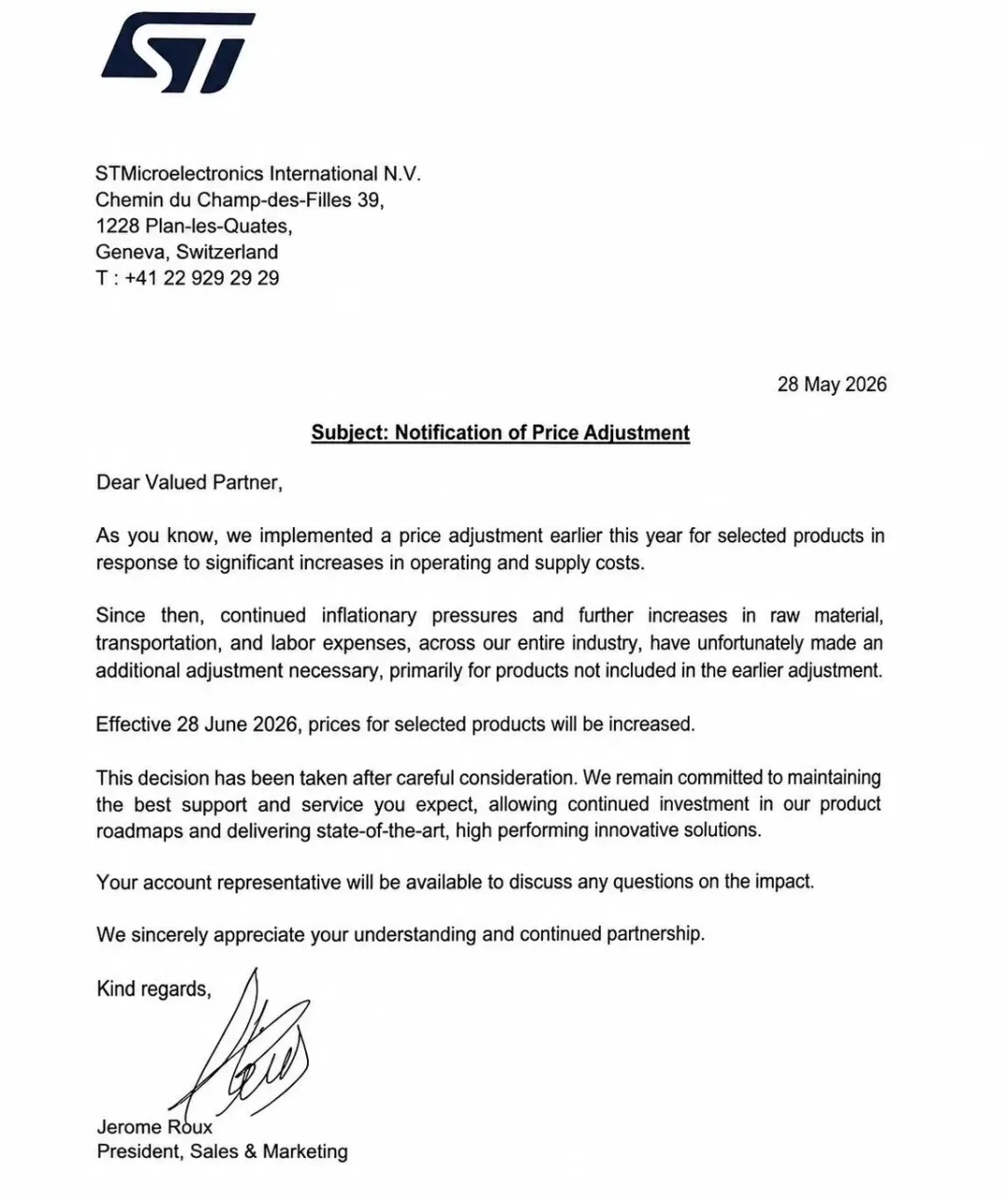
Then, at the end of May, another price-increase notice from ST emerged in the market. It indicated that ST would implement price adjustments on certain products starting June 28, 2026. This adjustment mainly targeted products that had not been included in previous price revisions.
In late June, Taiwanese media reported that STMicroelectronics had notified customers that a new round of microcontroller (MCU) price increases was expected to take effect on June 28.
The report, citing data from research firm Omdia, noted that ST's market share in general-purpose MCUs has recently reached an all-time high, and the company has held the top position in the general-purpose MCU market for five consecutive years. Its products are widely used in the Internet of Things (IoT), wearable devices, industrial automation, and consumer electronics.
The report mentioned that, driven by the recent trend of Edge AI, ST faced simultaneous increases in wafer foundry costs and end-market demand in 2026, and has therefore initiated price increases on certain MCU products to pass on costs.
In its 2025 annual report, ST stated that in 2025, approximately 25% of its total silicon production was subcontracted to external foundries.
According to ST's official website, the company's external wafer foundry partners and OSATs (Outsourced Semiconductor Assembly and Test providers) include TSMC (FinFET technology), Samsung Foundry and GlobalFoundries (FD-SOI ecosystem), Hua Hong (China supply chain), as well as ASE and Amkor (advanced BGA and WLCSP packaging).
On the same day, Taiwanese media reported that major U.S. investment banks expect that as mature-process foundries allocate more capacity to AI power-related applications, while new capacity additions remain limited, the supply tightness in the MCU industry is likely to persist into the second half of the year, with spot prices further rising.
ST is not the only one—a number of domestic and international MCU companies have recently issued price-increase notices one after another. A partial summary is as follows:
Nations Technologies: Issued a notice on March 26, raising prices on certain products by 15%–20%, effective April 7.
Puya Semiconductor: Issued a notice on March 31, increasing prices on general-purpose MCU-related products, effective April 15.
Wuhan Xinyuan Semiconductor: Issued a notice on April 21, implementing a new pricing system for its entire product line, with all product prices to be renegotiated, effective May 6.
NXP Semiconductors: Issued a notice on May 1, adjusting prices on certain products, effective June 1.
Infineon Technologies: Issued a notice on May 26, adjusting prices on certain products, effective July 1.
STMicroelectronics: Issued a notice on May 28, adjusting prices on certain products, effective June 28—this marks its second round of price hikes this year.
Nuvoton Technology: According to Taiwanese media reports, issued a notice on May 29, adjusting prices on certain product lines, effective July 1, with actual increases and specific products to be communicated to customers separately.
Holtek Semiconductor: As reported by Taiwanese media on June 12, recently implemented selective price increases on low-margin product lines and projects.
Fremont Micro Devices: Issued a notice on June 15, raising prices on its 8-bit MCU products by 5%, effective immediately.
Geehy Semiconductor: Issued a notice on June 17, adjusting prices on certain products, effective July 1.
02 Reasons for the Price Hikes
As for the reasons behind this round of MCU price hikes, a comprehensive view shows that they stem mainly from two factors—rebounding demand and constrained supply—compounded by rising upstream costs. Judging from the wording of various price-increase notices, the official reasons given by manufacturers also largely fall along the two lines of cost and capacity.
Many manufacturers cite cost as the primary reason in their price-increase notices.
Geehy Semiconductor stated that in recent quarters, substantial increases in upstream raw material costs, along with rising costs for wafer foundry, packaging, and testing, have put pressure on the industry supply chain. Wuhan Xinyuan Semiconductor mentioned the continued rise in core upstream raw materials such as wafers and packaging and testing services. STMicroelectronics cited inflationary pressures, as well as increases in raw material, transportation, and labor costs, as the main reasons for its latest price adjustment. NXP listed multiple cost factors—including raw materials, energy, labor, logistics, and supplier inputs—and noted that these were "beyond the company's control."
According to a report by Securities Times, prices of precious metals used in packaging, such as copper and silver, have remained at elevated levels. The latest price of the main Shanghai copper futures contract is approximately 105,400 RMB per ton, up more than 34% from the same period last year; LME copper has risen over 42% in the past year.
At the same time, wafer foundry and packaging and testing costs have increased significantly. A number of wafer foundries have already announced price hikes for mature process nodes: Nexchip announced a blanket 10% price increase on all its foundry services, effective June 1, 2026; Powerchip stated in the first quarter of this year that it has been raising prices successively, primarily adjusting product lines with lower gross margins; United Microelectronics Corporation (UMC) indicated that it expects to officially raise wafer foundry prices in the second half of 2026.
On the capacity front, Securities Times noted that as global semiconductor investment tilts toward higher-margin AI chips and advanced processes, new capacity for mature processes remains limited. TrendForce indicated that the average 8-inch capacity utilization rate among the world's top ten wafer foundries is expected to rebound to nearly 90% in 2026, a significant improvement from nearly 80% in 2025, and that the relevant foundries have successfully reflected the price increases to their customers.
This point is also reflected in some of the price-increase notices: Fremont Micro Devices mentioned "recent tight upstream capacity," Wuhan Xinyuan Semiconductor cited "tight industry capacity supply, where existing prices can no longer support future capacity guarantees and deliveries," and Infineon stated in its notice that it would accelerate investment in capacity expansion.
On the demand side, according to analysis by Taiwanese media, the continued expansion of AI data centers is driving demand for PMICs, control chips, power devices, and networking/communications chips. Meanwhile, industrial control, automotive electronics, energy management, and networking equipment—after two years of inventory adjustments—have resumed restocking, leading to a simultaneous uptick in demand for mature process nodes.
Among the aforementioned price-increase notices, Infineon explicitly cited demand as a factor. Its notice stated that demand for its product portfolio "has risen significantly, and much more broadly than anticipated just a few months ago," and that the company can no longer absorb the costs on its own.
03 onclusion
In summary, from international giants to Taiwanese manufacturers, multiple MCU companies have successively adjusted prices or issued price-increase notices over the past few months. At present, this round of price hikes is primarily driven by rising costs and tight capacity in mature process nodes, while demand is recovering under the impetus of AI and other applications. However, the actual implementation of these price increases and the acceptance by end customers still require ongoing observation.


 Whatsapp
 Email
Email Skype
Skype