

What’s really going on with the “crazy” TI automotive chips?
01 What’s the latest with TI automotive-grade components?
In recent weeks, “TI automotive-grade components are on fire” has almost become a consensus in the chip spot market. In addition to more discussions and purchase inquiries in industry groups, related posts have also begun to appear on social platforms.
Some people say, “For market parts (with the suffix) carrying Q1, are the quotes really more than ten times higher?” Others say, “Components that were ordered back for around a dozen yuan are now selling for two or three hundred.” Still others say that now “for those with Q1, regardless of whether they originally cost a few jiao or a few yuan, quotes are uniformly 350–500 yuan.”
On some third-party websites, quotes for certain TI automotive-grade components do show exaggerated increases. In June and July they were still in the tens of yuan, but this month they are already several hundred yuan, and the quote gaps between different sellers are also very large. One distributor complained directly: “TI quoting in the market has already become chaotic. Things that originally cost tens of yuan are now being quoted at several hundred, or even over a thousand.”
At present, TI automotive chips are indeed hot, but they seem to be in a rather chaotic stage. Many chip distributors only know that “it’s hot” but do not know much about the specifics. Even distributors who do business in TI automotive-grade components do not all feel the same way right now.
The strongest feelings come from a friend who works in foreign trade. He said he has recently “bought quite a lot of high-premium parts with Q1.” In his view, the situation now is even “almost like it was during the pandemic.” Another distributor in foreign trade also said demand has been constant and deals are doing well. But another friend mainly doing foreign trade said there are many inquiries but few deals.
By contrast, Xiaolin, a trader mainly dealing in TI automotive chips, has somewhat different impressions.
According to her observations, starting in July there were early signs that TI automotive-grade components were heating up. The reason may be insufficient capacity on the original manufacturer side and extended lead times for certain parts, leading to shortages of some components.
In late September, Xiaolin felt that demand was not yet concentrated; no particular part number stood out as especially hot, nor were all part numbers hot, but some had already seen obvious price increases. She gave an example: an automotive-grade interface chip previously cost four or five yuan including tax; by the time they shipped it, the price had risen to 8 yuan, but the next day someone offered 10 yuan excluding tax.
Around the same time, we also compiled some purchase inquiries and shipment/offer information from third-party websites and industry groups. Demand for TI automotive-grade components was indeed relatively fragmented; some part numbers in demand were even quite niche, with very few quotes.
Recently, she can still feel the heat around TI automotive-grade components, but now “you need to have stock for it to sell well,” and it is still hard to say clearly which part numbers are the hottest.
Another chip trader, Amei, recently came across several part numbers whose prices had doubled. One part in the LM74700 series cost 1.75 yuan including tax in June; now its price has risen severalfold, and customers are still looking for stock. One part in the LM5148 series was 15 yuan including tax in early September; now it has been bid up to 30–40 yuan, and stock still cannot be obtained. Some parts in the DRV8718 and TPS4H160 series have also more than doubled in price, and likewise cannot be obtained.
However, Amei also mentioned that the market is currently rather “chaotic.” One part in the TMUX1308 series is not automotive-grade itself and originally cost only a few jiao, but now it has also been bid up to several yuan.
Putting everyone’s impressions together, the changes in TI automotive-grade components this round can roughly be arranged into a timeline.
Around July, some distributors had already noticed the early signs, and some said they had been buying goods successively in July and August. In August and September, some people clearly felt the change. More and more people in industry groups began mentioning that “many automotive-grade parts have been rising recently” and that “some have started to be in short supply recently.” However, at the end of September, some said that TI automotive chips seemed to have begun to pull back.
It truly took off only in recent weeks. Some distributors said that starting in mid-October, demand for automotive-grade components clearly picked up.
A platform also gave a similar description of the changes. In July, it mentioned that overall lead times had generally extended from the original 8–12 weeks to 16–20 weeks; in August, it mentioned that capacity for Q1 and other series was tight; in September, it mentioned that after TI announced a price increase on September 1, spot market prices fluctuated sharply, with components in the automotive, industrial, and server sectors seeing particularly notable increases.
Overall, TI automotive-grade components are currently somewhat “chaotic” in the spot market.
First, on pricing: many people reported chaotic quotes, and some even “quote randomly.” These situations are mainly concentrated in power chips, but the specific part numbers are relatively scattered. This is also where this round differs from past market booms. In the past, whenever there was a market rally, there would more or less be some generally recognized “hot part numbers,” but this time they are hard to find.
On the customer side, some distributors said they had already bought at a premium, but did not buy when quotes were absurd. Some also mentioned that end customers have begun to question the situation.
02 TI: Results Are Up—What About Automotive?
Can any signs of the heat in the spot market be seen on the original manufacturer side?
First, let’s briefly review TI’s situation in recent years. TI’s quarterly revenue reached a peak of $5.24 billion in Q3 2022, then began to decline. In Q4 2022, revenue turned negative year over year, and the downturn lasted for more than two years. In Q1 2024, quarterly revenue fell to $3.66 billion, the trough of this cycle.
In Q1 2025, TI’s revenue grew 11.1% year over year, marking the first return to positive year-over-year growth since Q4 2022. For the full year 2025, revenue was $17.68 billion, up 13% year over year.
After entering 2026, TI’s performance accelerated markedly. Revenue in Q1 through Q3 was $4.83 billion, $5.46 billion, and $6.06 billion, respectively, with year-over-year growth rising from 19% and 23% to 28%. Second-quarter revenue had already surpassed the 2022 peak, and third-quarter revenue rose further.
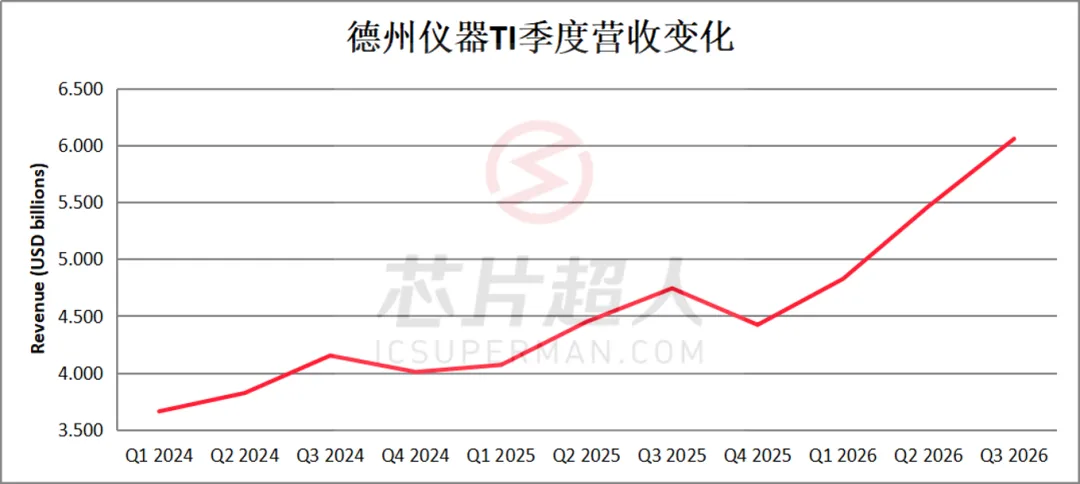
Source: TI earnings report
By market, the strongest performers this year have been industrial and data center. In the first quarter, TI said these two markets were “continuing to accelerate.” By the second quarter, TI CEO Haviv Ilan said that growth over the past several quarters had mainly come from industrial and data center, and that demand was now beginning to expand into the automotive market as well. In the third quarter, he mentioned “continued broad-based growth in industrial, automotive and data center.”
As can be seen, starting from the second quarter of this year, automotive began to become a key contributor to revenue growth.
Automotive has in fact always been one of TI’s most important markets. In 2025, TI’s automotive revenue was about $5.8 billion, accounting for 33% of total revenue and tying for first place with industrial.
However, in the early stage of this recovery, automotive growth was not fast. In 2025, TI’s data center revenue grew 64%, industrial grew 12%, and automotive grew 6%. In the first quarter of this year, the automotive business grew by a mid-single-digit percentage year over year and was roughly flat quarter over quarter. Haviv said at the time that “it is still too early to judge now,” and noted that in the pandemic cycle, automotive was “the last to join and also the last to peak.”
In the second quarter, the automotive business grew by a percentage in the teens year over year. Haviv said automotive demand built up gradually during the quarter, driven by China, mainly by electric vehicles and hybrids; at the same time, automotive customers had already reduced inventory to very low levels.
In the third quarter, the automotive business continued to grow by a percentage in the teens year over year and by about 10% quarter over quarter, with growth mainly coming from China and the United States. Among that, growth in hybrid, electric and powertrain-related businesses was about twice that of automotive overall.
Haviv said the growth momentum in automotive demand is quite strong, but he believes customers are not holding, nor maintaining, excessive inventory. TI itself is already prepared for growth and will use inventory previously built up to support some customers, but its fabs cannot immediately produce the corresponding product mix; for some more special part numbers, it needs to respond based on customer demand.
What about TI’s overall inventory, lead times and pricing?
On inventory, as of the end of Q4 2025, TI’s days of inventory increased to 222 days from 215 days in Q3. In Q1 through Q3 of this year, the figures were 209 days, 196 days, and 194 days, respectively, marking three consecutive quarters of decline.
On lead times, in Q1 this year Haviv also said, “We don’t have a supply shortage problem.” By Q3, he mentioned that strong demand was putting pressure on lead times and that lead times “may have risen slightly.” TI also said some areas would be tighter, but believes its lead times remain competitive.
On pricing, on the Q3 earnings call, TI said product prices in the first half of 2026 were basically flat year over year. After entering the second half, prices rose to some extent, but this year’s increase was not significant. At the same time, TI has begun discussing 2027 pricing and supply assurance. TI said more information on price changes may not be available until it reports results, especially issues guidance, in January next year.
TI has already initiated three price increases this year, in April, July, and September respectively. The multiple rounds of price adjustments mainly point to rising supply chain costs and changes in the market environment, combined with recovering demand in industrial control, automotive, and data centers. TI’s overall lead times have also continued to extend, with lead times for some part numbers reaching 48 weeks or more.
03 Concluding Remarks
On one side, quotes for TI automotive-grade components in the spot market are chaotic, and different players have different impressions; on the other side, the original manufacturer’s results have hit a new high, and automotive customers’ inventory is low. Whether this round is a replenishment driven by real demand or short-term heat driven by sentiment, and where it will ultimately go, still require continued observation.


 Whatsapp
 Email
 Skype